Engineers are worthless now? Yet the software market is surging toward $58.2 billion: when 180 million people can make software, AI is turning software creation into the next growth frontier
Recently, I've talked with many fellow engineers, engineering managers, tech leads, and investors who once invested in software, and they all independently bring up the same thing: has the software industry already died because of the rise of AI?
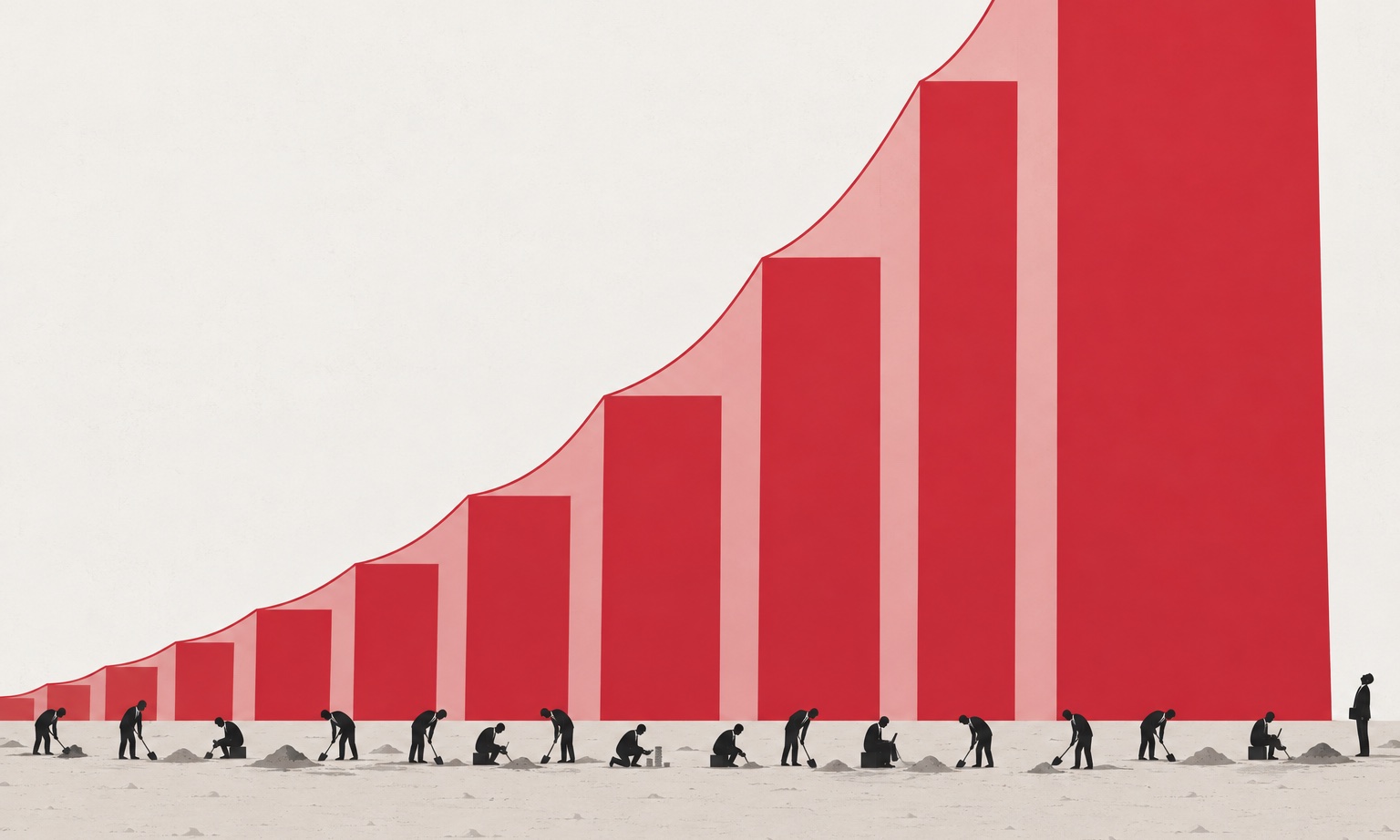
Are investors really planning to stop pouring resources into the software industry? This is actually a huge question mark. Because if we shift our perspective back to the market itself, although programmer job openings are projected to decrease by 7% over the next ten years, the population of people making software has surged by 36 million in a single year. So, what AI is actually suppressing is the "price of writing code," but what it's expanding is the entire software market.
As I see it, the software market is experiencing the largest expansion in its history, and the driving force behind this expansion happens to be the very thing making engineers anxious: AI can now write code. AI has turned the technical language once required for digital environments into ordinary human speech, accelerating the communication time between two species (humans and digital intelligent agents).
Let me state the conclusion up front. The U.S. Bureau of Labor Statistics projects that the "Computer Programmer" occupation will decrease by 7% over the next decade; but the reality is that, during the same period, GitHub added more than 36 million new developers in a single year, and Gartner projects the low-code development technology market will reach $58.2 billion by 2029. Put these three numbers together, and they're telling the same story: the barrier to entry for writing code has become cheap and easy, so there's more software — and therefore more people making software. One particular kind of engineering job will disappear, but the software market will become several times larger.
Since starting my business — even earlier, since I wrote my first line of HTML code back in 1995 as a kid — the world as I've understood it has always been an accelerating world. Computers aren't fundamentally that different from humanity's past information carriers; they can just do a great many things. They're the same as radio, television, even film as content carriers — except they can achieve faster speeds, reach more people, and carry more functions.
When Aotter was founded in 2013, we were running a lot of co-creation communities, or what was then — nearly 15 years ago — the booming Maker community. Through manufacturing equipment moving from factories into homes, combined with the spread of smartphones and mobile apps, we built a world where products could be made much faster. Self-media was the same way — from needing large-scale, expensive production equipment, it gradually shrank down to just a green screen, a phone, and LED lights in a small space, achieving results close to what a professional studio used to deliver. This is a concrete manifestation of technology shortening the distance to value creation.
The one place where the digital content industry (or what we might call the "brain" industry) still seemed a bit behind, was that technical personnel — software engineers — remained scarce, and the market still exhibited the "scarcity equals value" phenomenon that comes from that shortage. Companies with resources or capital, ignoring the real productivity per person-month, used "having more engineers" as one of their indicators of productivity or quality assurance — and this is precisely the kind of phenomenon that only shows up in a relatively backward industry.
Over these past years of writing code, building products, and leading teams myself, watching Full-stack Frameworks and various libraries that over-complicate what used to be simple front-end languages, and then the AI era — moving generation by generation through Copilot, Cursor, Claude Code, Codex, Vibe Coding, Agents — I've become increasingly certain of one thing: the thing that is truly shrinking, when you zoom out and look at the big picture, is the constraint itself that "only Programmers can create Software."
Below, using data from five authoritative institutions, I'll talk about the market changes I'm seeing, and the new role being born within this change: the Software Creator. I don't even think "Builder" is the right term to describe this role that has been springing up like mushrooms after rain, driven by vibe coders.
I. Programmers Are Shrinking, Software Developers Are Growing
A lot of people lump "people who write code" together with "people who make software" when counting, which is why they end up asking the wrong question.
The U.S. Bureau of Labor Statistics' (BLS) latest 2025–2035 occupational employment projections happen to count these two groups separately:
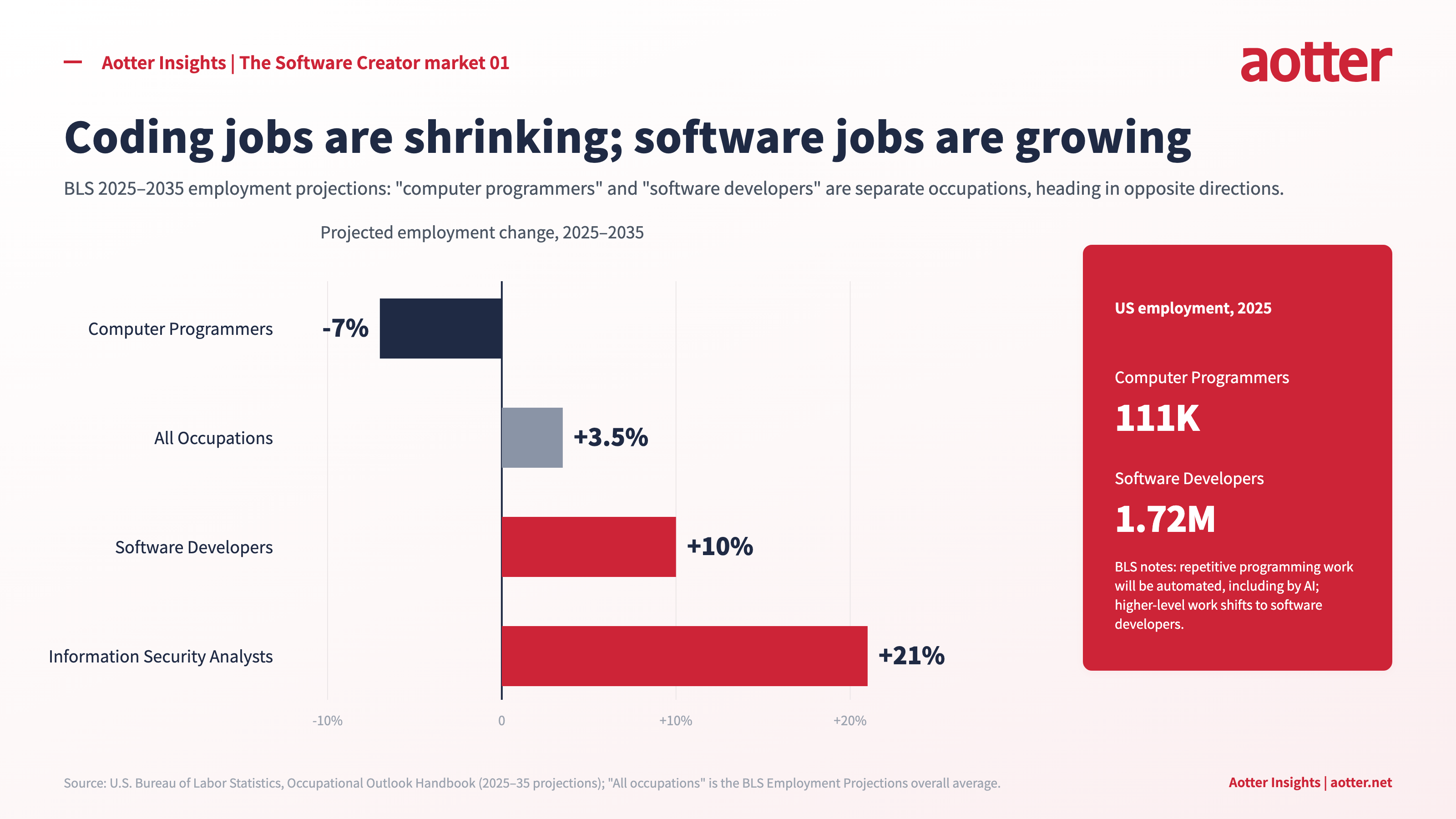
Computer Programmers are projected to decrease by 7%, Software Developers are projected to increase by 10%, and Information Security Analysts are projected to increase by 21%; over the same period, all occupations on average will grow by only 3.5%. The BLS states it directly on the Computer Programmers page: companies will use technologies including AI to automate repetitive programming work, while higher-level work shifts to software developers.
What this chart tells us is a structural shift: "Coding" is losing value, while "Software" is gaining value.
As more and more code can be handed off to AI to write, human value will shift elsewhere. Do you know what problem needs solving? Do you understand how this industry operates? Can you organize the needs of five departments into a single workflow? Do you know how data should be modeled? Do you know which decisions shouldn't be left to an Agent? Do you know where things will blow up once it's in Production? Going one level deeper: do you understand Databases, Distributed Systems, Security, Infrastructure?
These abilities will be worth more than "turning specifications into Code."
II. The Definition of "Developer" Is Expanding: 48.4 Million, or 180 Million?
How many developers are there really? The answer depends on how you count; and the gap between the two ways of counting is exactly what's most worth looking at in this market.
SlashData's estimate is that there were 48.4 million developers worldwide in Q3 2025, up from just over 31 million in early 2022 — about a 50% increase in a little over three years; within that, professional developers grew from 21.8 million to 36.5 million, a 70% increase. SlashData also notes that the annual growth rate has fallen from 15% and 21% to 10% in the most recent year, possibly indicating a slowdown.
GitHub's numbers are on another order of magnitude entirely. The Octoverse 2025 report: the platform now has over 180 million developers, with more than 36 million joining in a single year (23% year-over-year growth), averaging more than one new join per second; nearly 80% of new developers used GitHub Copilot within their first week. Public repos using an LLM SDK exceed 1.1 million, up 178% year-over-year.
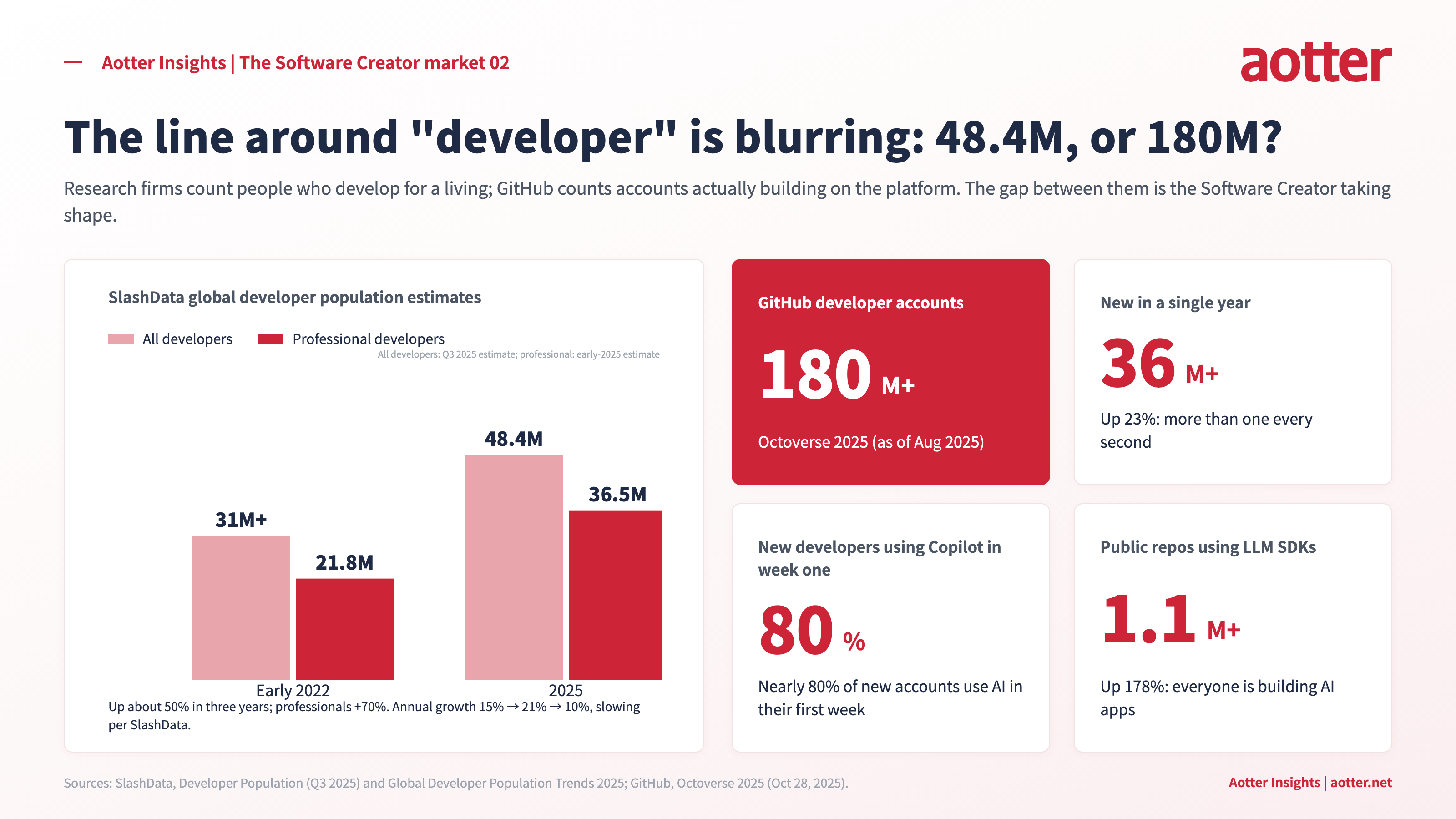
180 million GitHub accounts obviously doesn't equal 180 million professional engineers. Research institutions are counting "people whose profession is development," while GitHub is counting "accounts actually building things on the platform." The gap between these two numbers is precisely the group of Software Creators that's growing right now.
In the past:
Software Creator ≈ Programmer / Engineer
Now it's gradually becoming:
Software Creator
= Engineer + Founder + PM + Designer + Analyst
+ Marketer + Consultant + Operator + Researcher
+ Average Users + AI Agents
Gartner predicted back in late 2022: by 2026, developers outside of formal IT departments will account for at least 80% of users of low-code development tools, up from 60% in 2021. These people don't have "Software Engineer" on their LinkedIn, but they're creating software every day.
I've deliberately avoided throwing out a number like "how many Software Creators there will be by 2027" here, because no research institution has done this kind of population forecast yet, and any number I guessed myself wouldn't be any more credible. But the direction is quite clear: professional developers are still growing, but slowing down, while the population of people making software is expanding at a different speed.
 AI Advisory · Powered by MCP
Want to go deeper? Make AOTTERSMAN your AI advisor
The full reasoning and hands-on checklist behind this insight live in the AOTTERSMAN knowledge base. Install the MCP and your existing AI assistant (Claude / Cursor / Gemini…) can tap AOTTERSMAN's thinking frameworks directly — like having an extra AI advisor always on call.
The first step of enterprise AI transformation
Get data governance right first, so AI projects don't stall on messy data.