Are engineers becoming worthless? Yet the software market is racing toward $58.2 billion: when 180 million people can all build software, AI is turning software creation into the next growth frontier
I've recently been talking with a lot of fellow engineers, engineering managers, tech leads, and investors who used to back software companies, and they all keep bringing up the same thing: is the software industry dying because of AI's rise?
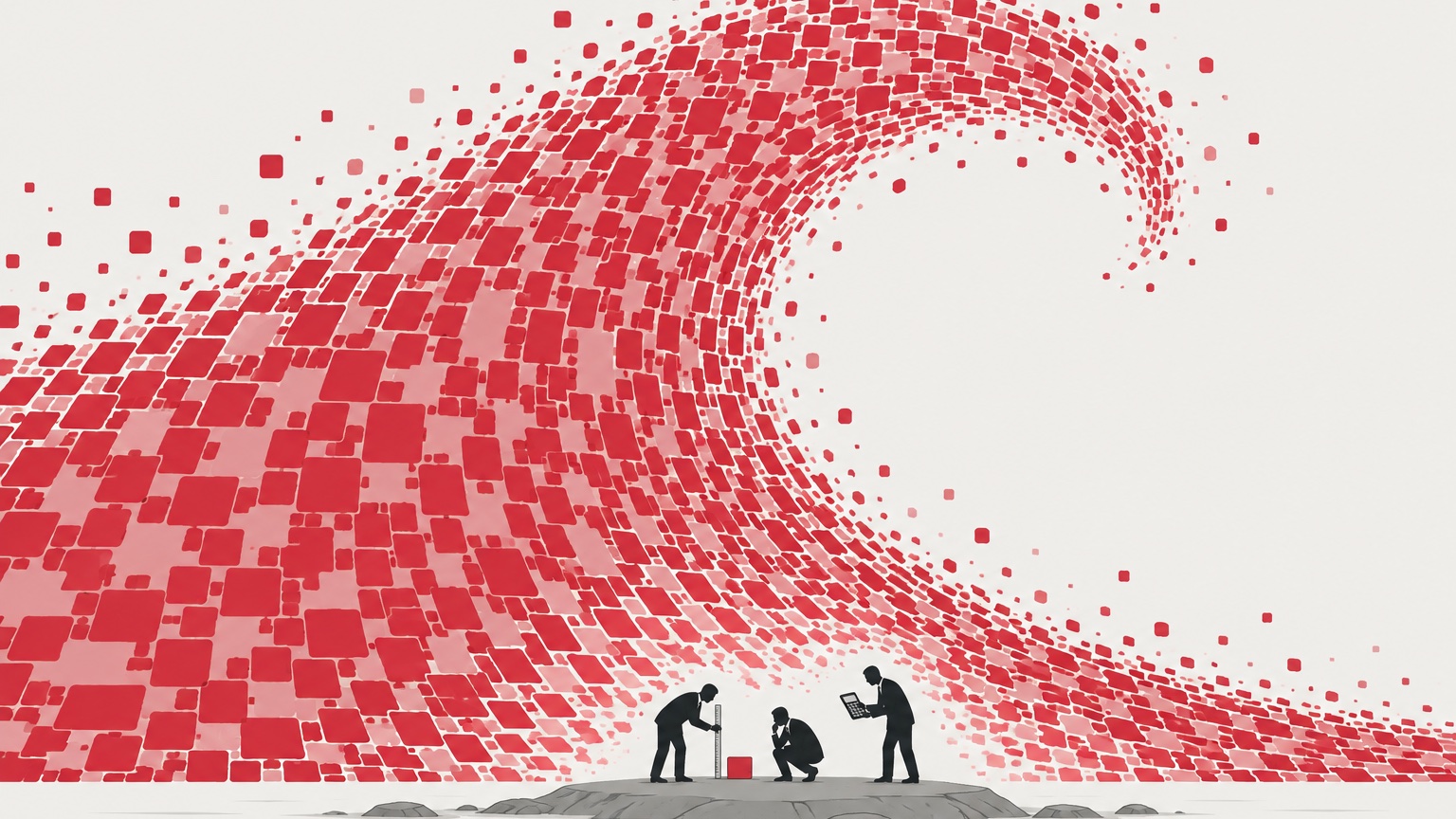
V. The Software Market Is Shifting From "Enterprise Procurement" to "Everyone Creates": $58.2 Billion Is Just a Number Under an Outdated Category
My judgment is that most people's current estimates of the AI coding market are too small, because they're still calculating it as "number of developers × IDE subscription fee."
Let's start with the data. Gartner's November 2025 forecast: the global low-code development technology market will reach $58.2 billion by 2029, with a projected CAGR of 14.1%; Gartner's forecast in late 2022 for 2023 was $26.9 billion. Looking just at the segment Gartner originally defined as low-code, it's roughly doubled in about six years. More importantly, the growth drivers Gartner names are: Agentic AI and Citizen Development.
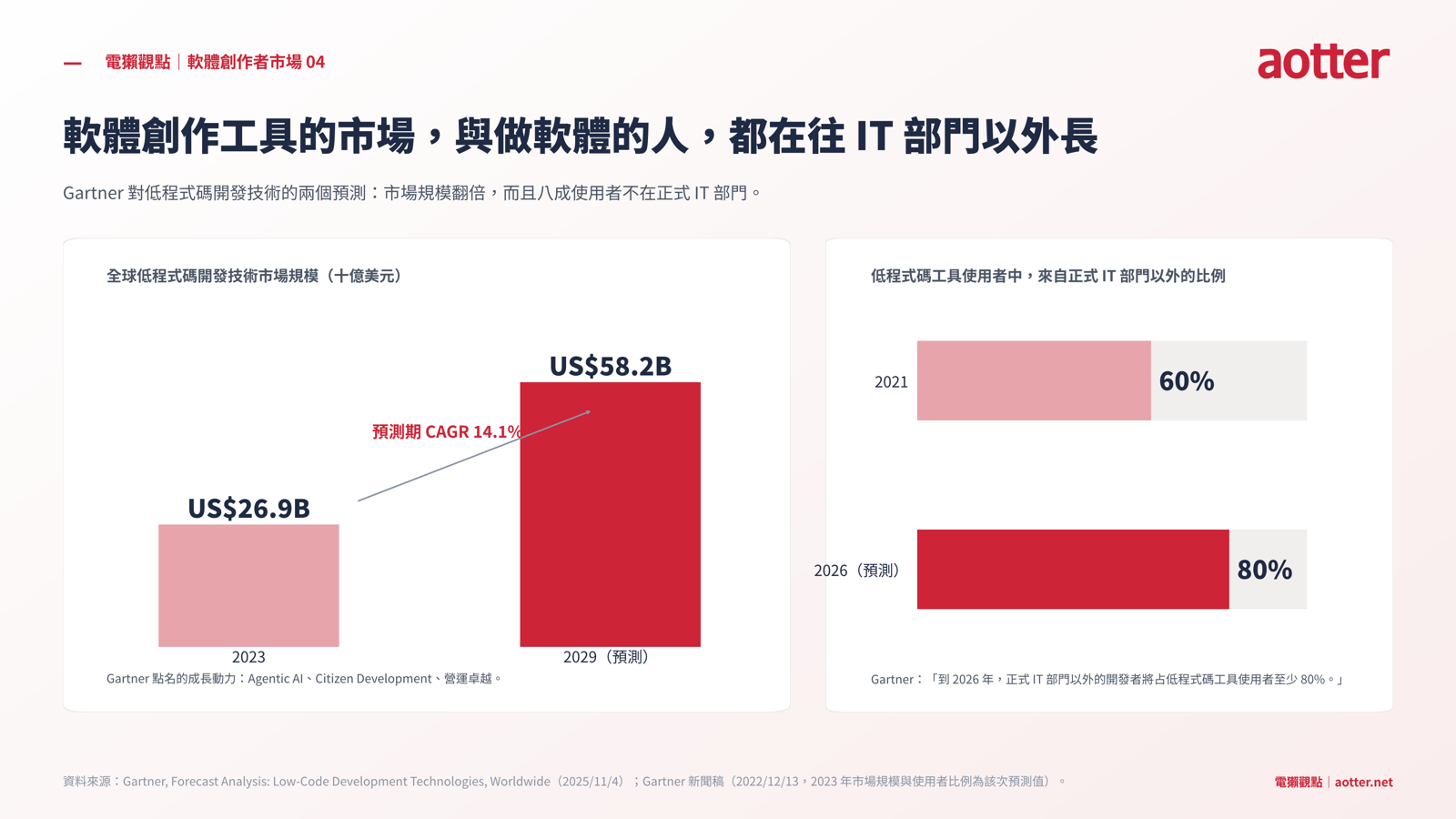
Low-code is still a category from the previous generation. Low-code still assumes "a human operating a builder"; AI-native software creation already assumes "a human stating intent, an Agent operating the builder." This is a market of an entirely different order.
Venture capital's take is also worth considering (this is an opinion, not statistical data). In March this year, a16z published a piece titled "Good news: AI Will Eat Application Software," directly pushing back against the pessimistic market view that "AI will kill SaaS": "As code gets cheaper, we should expect demand for more software," and "we are nowhere close to satisfying the world's demand for quality software." By August, they put it even more bluntly: "AI coding may be the largest addressable market we encounter in our lifetimes."
In the past, before turning a need into software, you had to ask "is it worth spending a million dollars on this?" Now it's "is it worth spending an afternoon on this?" That's a completely different economic model.
Let me give a somewhat silly but very illustrative example of this future. Five friends go to Japan, come back to the hotel at night, start drinking, and suddenly realize, "damn, we don't have a board game." Today, we'd go to the App Store, search for a game, download it, register, watch ads, study the rules—and we might not even find one suited for exactly five people. A few years from now, it's entirely plausible that one of them will just tell an Agent: "There are five of us—build us a 30-minute party game with some psychological bluffing, playable together on our phones, join by scanning a QR code." The Agent spends a few minutes building the game state, generating a web UI, opening a room, producing a QR code, deploying it. Two hours later, the game's over, and nobody ever uses it again.
This thing's entire lifecycle is just two hours, but it genuinely created value. In the past, this kind of software didn't make sense because development cost > usage value; in the AI era, we'll start seeing cases where development cost < one-time usage value. Once that equation flips, the sheer number of software products is going to explode.
The concept of "an app" itself will change too. In the past, it was "someone spends months building it → it ships → everyone downloads it"; in the future, we'll see more and more just-in-time applications: I need it, so I build it now, and once I'm done using it, that's that. Some will stick around, some will iterate, some will live for 30 minutes, and some will grow from a tiny tool into an entire SaaS company.
So the real question to ask is: when hundreds of millions of people occasionally create software, what infrastructure will they need? This is a completely different TAM.
VI. The Better AI Gets at Writing Code, the More Valuable the Infrastructure Layer Becomes
Let me state the conclusion first: code generation will be the most fiercely competitive, thinnest-margin layer of this wave; the layer that's genuinely hard—and genuinely huge—is "what happens after it's built."
OpenAI, Anthropic, Google, Cursor, Replit, and Lovable are all working on code generation, and every model will inevitably keep getting better at it. "Generate me a button" going wrong isn't a big deal; "touch the production database" is a completely different matter. Once AI makes the front half of software creation cheap, the back half becomes even more important: data, permissions, identity, business logic, deployment, monitoring, rollback, audit, security, human-in-the-loop. What exactly can an Agent do? And when does it absolutely have to ask a human first?
Four numbers from different institutions all point in the same direction:
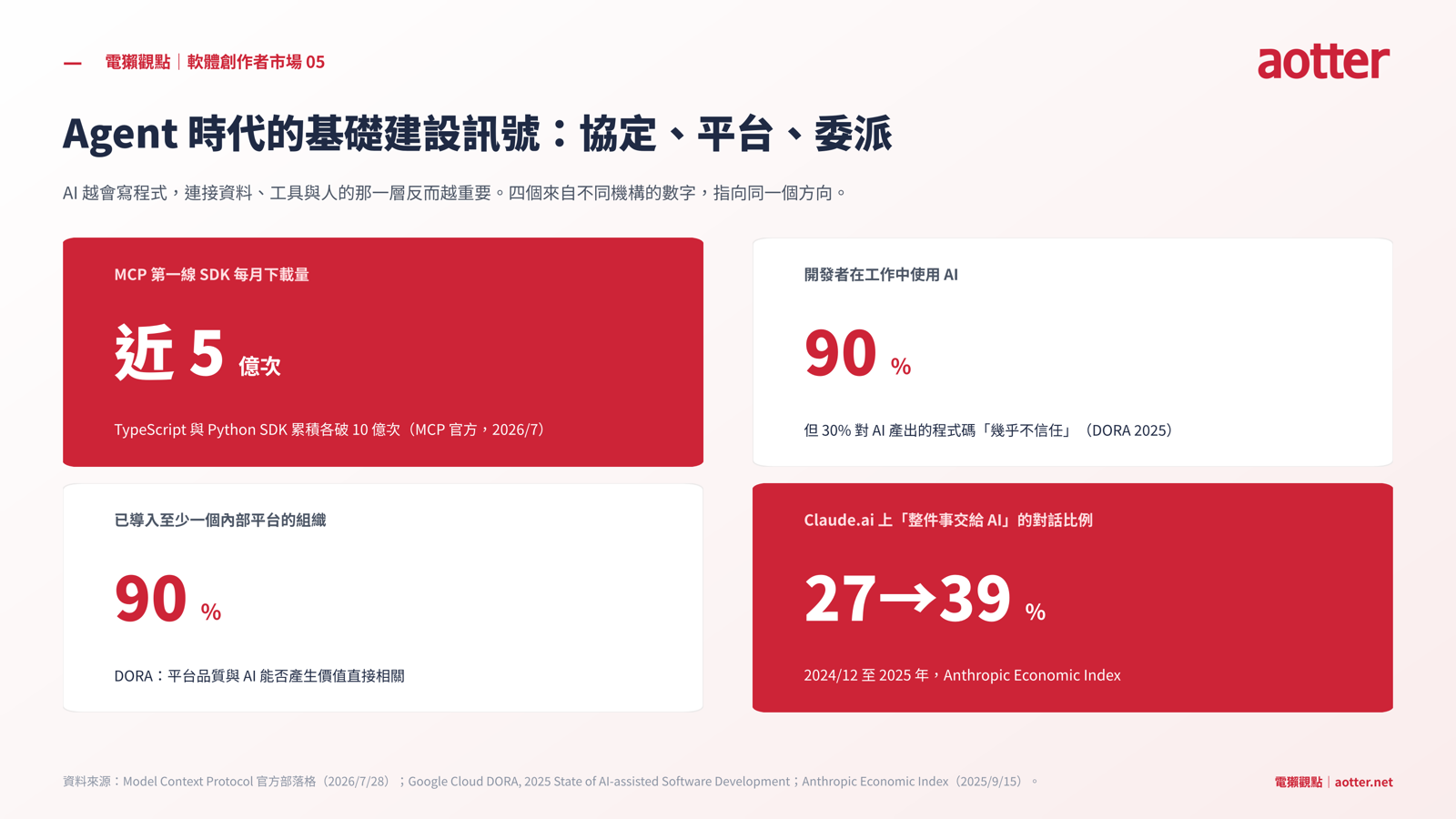
First, platforms. Google Cloud's 2025 DORA report puts it plainly: AI doesn't fix a team, it amplifies whatever was already there. 90% of respondents use AI at work, over 80% believe it increases productivity, but 30% have almost no trust in AI-generated code; AI adoption correlates positively with delivery throughput but negatively with delivery stability. DORA's conclusion: 90% of organizations have already adopted at least one internal platform, and platform quality is directly tied to whether an organization can actually capture value from AI. The better AI gets at writing code, the more important the platform layer becomes—these two things aren't contradictory at all.
Second, protocols. MCP's growth rate is genuinely staggering. When the official MCP team released the new spec version in July 2026, they disclosed that first-party SDKs are seeing nearly 500 million downloads per month, with the TypeScript and Python SDKs each having crossed 1 billion downloads cumulatively. What MCP fundamentally solves is simple: letting an Agent know what tools exist, how to call them, which data it can read, and which actions it can execute.
MCP still largely lives in the server/backend world. This year, WebMCP started to fill in the other half: co-drafted by engineers from Google and Microsoft, housed under the W3C Web Machine Learning Community Group, first made public in August 2025, it's still a draft and has not yet become an official standard; Chrome began an Origin Trial for it in Chrome 149 in June 2026. WebMCP lets a website directly tell an Agent "I have searchProduct, addToCart, createBooking, approveExpense," replacing "look at a screenshot, guess which element is a button, move the mouse, click, screenshot again, guess again" with structured tools. WebMCP's own documentation states it clearly: it's designed to complement existing backend protocols (such as MCP), not replace them; a webpage that implements WebMCP can be treated as an "in-page MCP server."
The way I think about it:
MCP     = The API Layer of the Agent era
WebMCP  = The Interactive Web Layer of the Agent era
The role of the web is becoming hugely important again as a result. It's the most ubiquitous, most cross-platform application runtime in the world, with nearly zero installation cost. For that game dreamed up on the spot at the hotel, nobody's going to want to package it as an iOS app and submit it for review—the most natural path is Agent → generate → deploy → URL → QR code → browser, usable within five minutes. As just-in-time software proliferates, the URL will become a critically important application distribution layer once again, and the browser will simultaneously serve as both the human interface and the Agent interface.
Third, delegation. Anthropic's Economic Index is already seeing usage patterns shift: the share of "directive" conversations on Claude.ai—where the entire task is handed directly to AI—rose from 27% in December 2024 to 39% in 2025; 44% of enterprise API usage falls into computer-and-math-related work, an even higher concentration than the 36% seen on Claude.ai. People are gradually shifting from operator to intent-setter, reviewer, decision-maker, and owner.
Put these three signals together and you get a single paradigm shift: in the future, from the very first day a piece of software exists, it should assume that both humans and Agents will use it. Today we design APIs because software needs to talk to software; in the future, from Day 1, a huge share of applications will need to account for both the human UI and the Agent tool interface at the same time.
 AI Advisory · Powered by MCP
Want to go deeper? Make AOTTERSMAN your AI advisor
The full reasoning and hands-on checklist behind this insight live in the AOTTERSMAN knowledge base. Install the MCP and your existing AI assistant (Claude / Cursor / Gemini…) can tap AOTTERSMAN's thinking frameworks directly — like having an extra AI advisor always on call.
Permission governance you can trust
Fine-grained data permissions ensure the right people — and the right AI — see the right data.