Are engineers becoming worthless? Yet the software market is racing toward $58.2 billion: when 180 million people can all build software, AI is turning software creation into the next growth frontier
I've recently been talking with a lot of fellow engineers, engineering managers, tech leads, and investors who used to back software companies, and they all keep bringing up the same thing: is the software industry dying because of AI's rise?
III. Software Creator: A New Role Officially Arrives, and Its Momentum Can No Longer Be Ignored
Put the two sets of data above together, and you'll see a new role has already taken shape: the Software Creator. They make software, but their work, their tools, their output, and their responsibilities are all different from the Programmer we're familiar with. This role is becoming the single biggest driving force in the next phase of the software market, and the evidence is already showing up in institutional data: GitHub added 36 million new developers in a single year, with nearly 80% using Copilot in their first week; Gartner projects that by 2026, 80% of low-code tool users will come from outside formal IT departments; the BLS projects that repetitive coding will get automated while higher-level work shifts to software developers. Three institutions, three angles, all looking at the same crowd pouring in.
This is a lot like YouTube's relationship to the video industry. Photographers, editors, and directors as professions still exist, but what really expanded the video market tenfold was the "Creator"—a role that didn't exist before at all. Software is replicating the exact same path.
I've broken down the biggest differences between Software Creators and Programmers into five points:
First, the starting point is different. A Programmer's work begins with a "spec"; a Software Creator's work begins with a "problem." They themselves are the person who understands the business, the person who deals with the problem every single day. A retail operations manager's restocking tool might end up closer to reality than one built by an engineer who doesn't understand retail at all, because the manager knows which column of numbers actually matters.
Second, the core tools are different. A Programmer's core skill is syntax and algorithms; a Software Creator's core skill is "clearly articulating intent" plus "judging whether the Agent got it right." Anthropic's Economic Index found that the share of conversations on Claude.ai where the "entire task is handed off directly to AI" rose from 27% to 39%—which is exactly this new way of working: humans handle intent and review, Agents handle building.
Third, the unit of output is different. A Programmer delivers "features"; a Software Creator delivers "outcomes." For a lead-gen app built by a salesperson, or a check-in tool built by an event PM, there's only ever one metric: did this month's problem get solved? That's why software built by Software Creators can have a very short lifecycle—sometimes living for just a single event or a single campaign.
Fourth, where they're positioned is different. Programmers cluster in IT departments and software companies; Software Creators are scattered across marketing, operations, finance, sales, customer service—every corner where repetitive work exists. That Gartner figure of "80% outside of IT" is exactly describing this.
Fifth, where responsibility lands is different. When code is generated by AI, the responsibility a Software Creator truly has to bear is judgment: can this ship? Was the data pulled correctly? Were permissions set correctly? In the Stack Overflow survey, 46% of developers don't trust the accuracy of AI output—which illustrates exactly where this role's value lies: between "almost right" and "actually right," you need someone who understands the business and can also read the results, to serve as the gatekeeper.
Put these five points together, and that's why I believe the Software Creator will become an independent role—and will become the single biggest driving force in the next phase of the software market: they outnumber professional developers several times over, they're scattered across every industry, and they're building software that would never have been built in the past.
IV. Talent Is Concentrating at Two Extremes, and the Middle Is the Most Dangerous Place to Be
I'd roughly divide the technical talent that will truly hold value in the future into two extremes—and the two look completely different from each other.
The first extreme is people who go very deep: people who genuinely research databases, compilers, operating systems, models, GPUs, security, distributed systems, infrastructure. AI can help them write code, but as the entire world is built on more software, more Agents, more APIs, the people who truly understand the fundamentals become even scarcer. If the number of people at the top increases a hundredfold, the people laying the foundation at the bottom won't increase a hundredfold at the same time. Truly strong infrastructure-level engineers will become fewer, more expensive, and more leveraged.
The other extreme is the opposite: people who understand one domain deeply and can also do a little bit of everything. Someone in advertising who understands media buying, media, sales, CRM, has some data skills, can write a bit of API code, can prompt well, understands some UX. In the past, this person touched everything but couldn't ship a product; now, with AI Agents, they may well be more capable of building "a product an ad agency would actually buy" than a Programmer who codes fast but doesn't understand advertising at all.
That huge middle chunk of work—"write the code according to the spec"—is the piece most easily compressed.
The numbers from Stack Overflow's 2025 Developer Survey explain exactly why "judgment" is becoming more valuable than "generation":
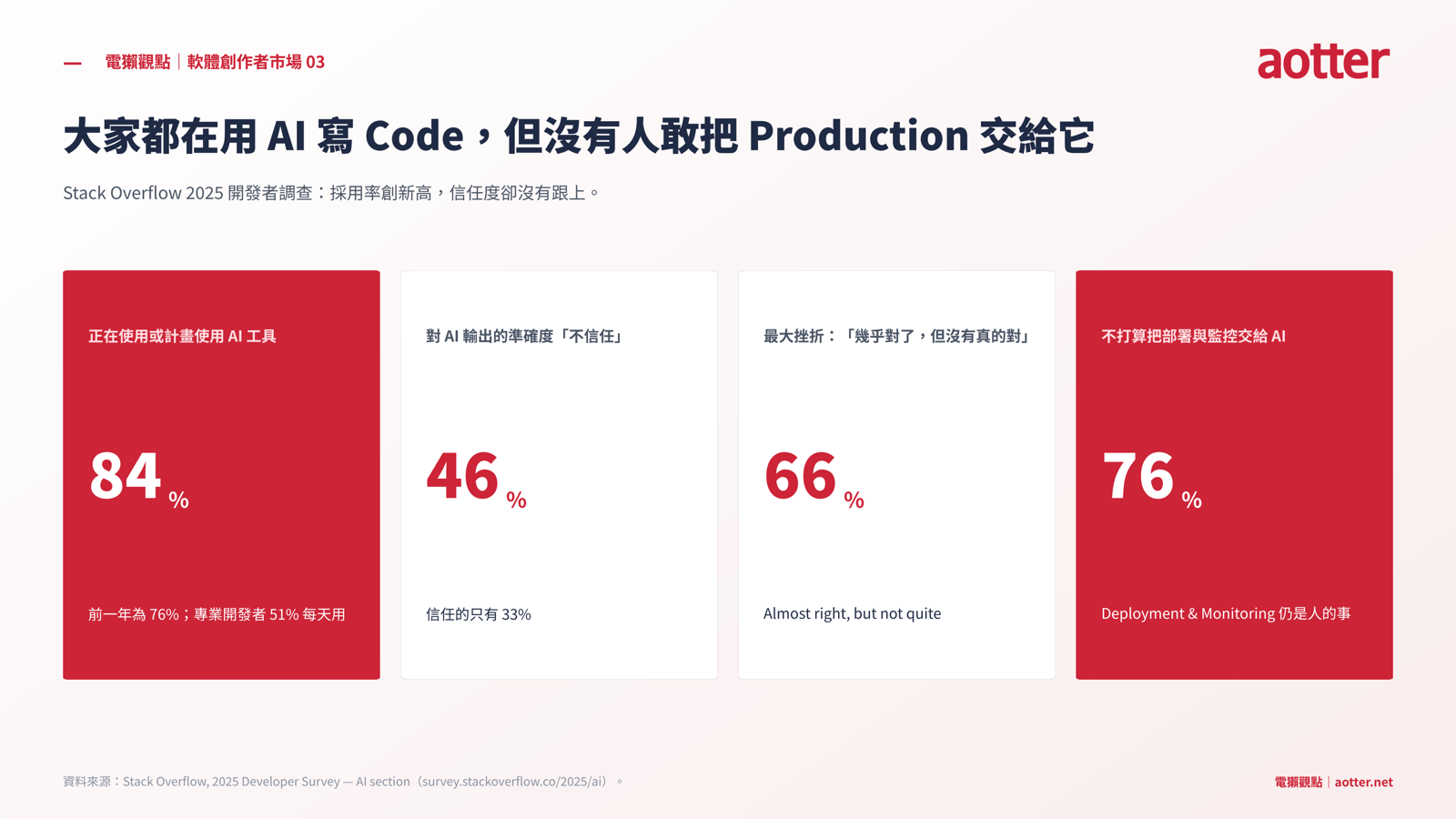
84% of developers are using or planning to use AI tools (up from 76% the previous year), and 51% of professional developers use it daily. But 46% don't trust the accuracy of AI output, with only 33% expressing trust; 66% say their biggest frustration is that AI output is "almost right, but not quite right"; 76% have no plans to hand deployment and monitoring over to AI.
Code generation is rapidly becoming a commodity. The genuinely hard work is shifting toward judgment, verification, architecture, domain knowledge, and accountability.
 AI Advisory · Powered by MCP
Want to go deeper? Make AOTTERSMAN your AI advisor
The full reasoning and hands-on checklist behind this insight live in the AOTTERSMAN knowledge base. Install the MCP and your existing AI assistant (Claude / Cursor / Gemini…) can tap AOTTERSMAN's thinking frameworks directly — like having an extra AI advisor always on call.
More than a chatbot
AotterClam is an enterprise-grade AI control layer that lets AI truly understand your company's data.