To Sell Electricity, You Also Have to Sell Lamps: AI's Seven Entry Points — Which Layer Should Service Providers Bet On?
We counted up the entry points into AI — there are seven. This article goes through them layer by layer, and along the way figures out where the "electricity" comes from at each layer and who pays the "electricity bill."
The real power grid: Agentic Browser and Agentic OS
Of the seven entry points, in the end, there might really only be these two left: the browser and the operating system. The reason is simple: users are lazy, and the power of "free" and "preinstalled" is enormous.
All web services run inside a browser, and all software runs inside an operating system. High market share means you just sit back and harvest.
The Gemini button in the top-right corner of Chrome still isn't very good right now, and Siri left everyone in despair for years before finally getting Siri AI in beta in September — but these are preinstalled on most people's devices. On Apple's side, the unified memory architecture is an incredibly strong buff: when the on-device model is good enough, it computes locally; when it's not, it escalates to Apple's own cloud. On the browser side, once WebMCP becomes widespread, websites just need to expose their tools, and the browser's agent will be able to use the user's own AI to operate them.
There's no doubt that OS makers and browser makers will favor their own AI. But they can give service providers a unified outlet: the user has electricity at home, there's only one plug standard, and which power company it's actually connected to matters much less to us.
For service providers, this is the real power grid. There's an outlet on the wall, and we no longer need to worry about whether the user has electricity at home or which power company they're connected to. We can finally specialize and focus on making good appliances.
We're betting on the appliance layer
So we're not betting on any particular power company — we're betting on the appliance.
More precisely, that means turning our service into tools and data that any agent can call, and connecting it one by one to the seven entry points: for the vendors' chat entry points, personal computers, IM, and always-on cloud agents, we're connecting via MCP right now; for the browser layer, we'll follow as soon as WebMCP becomes widespread; for the OS layer, we'll connect as soon as Apple's AI API opens up. It works no matter which AI the user uses; and once the power grid matures, these investments carry straight over — no need to start from scratch.
As for how we split the tokens, we look at the nature of the task:
- Lightweight, predictable inference, like classification, summarization, completion: we absorb the cost now, and hand it off to the OS in the future.
- Heavy, open-ended agent tasks: use the user's own AI subscription, with us providing the tools and data.
- What we pay for ourselves, limited to parts that directly convert into revenue, or where the harness itself is our business know-how.
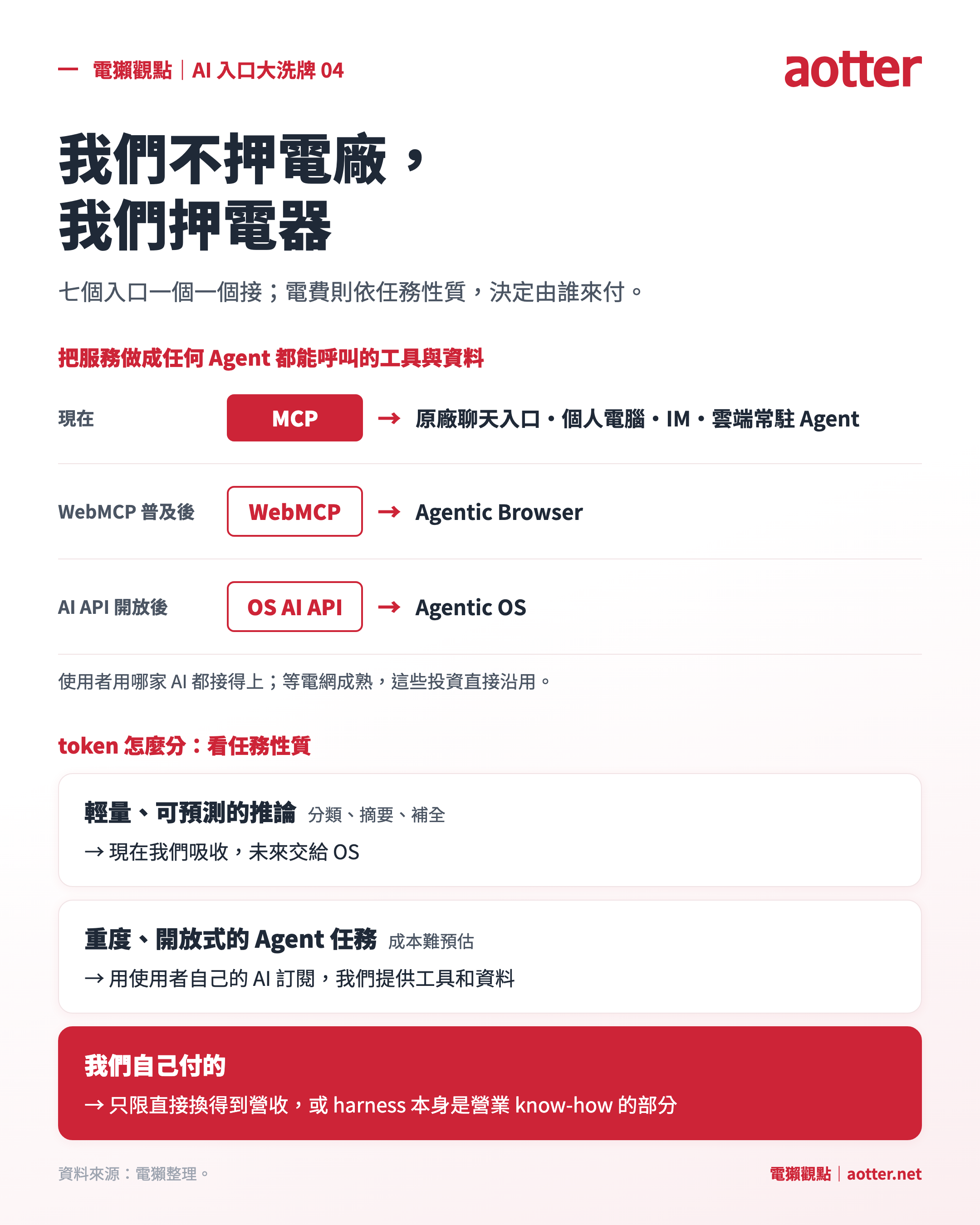
After the power grid becomes widespread
Once the power grid becomes widespread, that also means new gatekeepers will rise. Everyone's familiar with the App Store cut story — will OS and browser makers restrict APIs or favor their own services, taking a toll on AI too? And whoever's paying for the portion where on-device models aren't powerful enough and have to go to the cloud — who's that on? Maybe in a future where hardware compute bottlenecks get solved and inference costs drop, everyone gets free tokens to use? And if you want more, maybe it gets bundled and charged as part of an iCloud+ or Google One family package?
None of this has an answer yet. But we think the direction is clear: AI will increasingly resemble water and electricity utilities, and the ecosystem will eventually specialize: the model vendors will return to the role of infrastructure, generating and distributing power like a power company; the entry point will be handed over to browsers and OSes; and the value of service providers will return to the appliance itself. We'll keep watching.
Sources
- AUTOMATON, Developers of AI-powered driving game take out loan to keep Steam demo running after surge in players pushes AI costs past $1,000 a day
- InfoWorld, Meta’s ex launches agent rival to Meta’s Muse (Sept 29, 2026)
- INSIDE, 20 億美元併購案告吹!中國官方出手,攔截 Meta 對 Manus AI 的收購
- Trends across entry points: official announcements and product launches from OpenAI, Anthropic, Google, xAI, Meta, Apple, and LINE, compiled by Aotter (as of November 2026).
 AI Advisory · Powered by MCP
Want to go deeper? Make AOTTERSMAN your AI advisor
The full reasoning and hands-on checklist behind this insight live in the AOTTERSMAN knowledge base. Install the MCP and your existing AI assistant (Claude / Cursor / Gemini…) can tap AOTTERSMAN's thinking frameworks directly — like having an extra AI advisor always on call.
Data sovereignty stays in your hands
Models deploy inside your company — data never leaves your network, so adopting AI feels safe.