To Sell Electricity, You Also Have to Sell Lamps: AI's Seven Entry Points — Which Layer Should Service Providers Bet On?
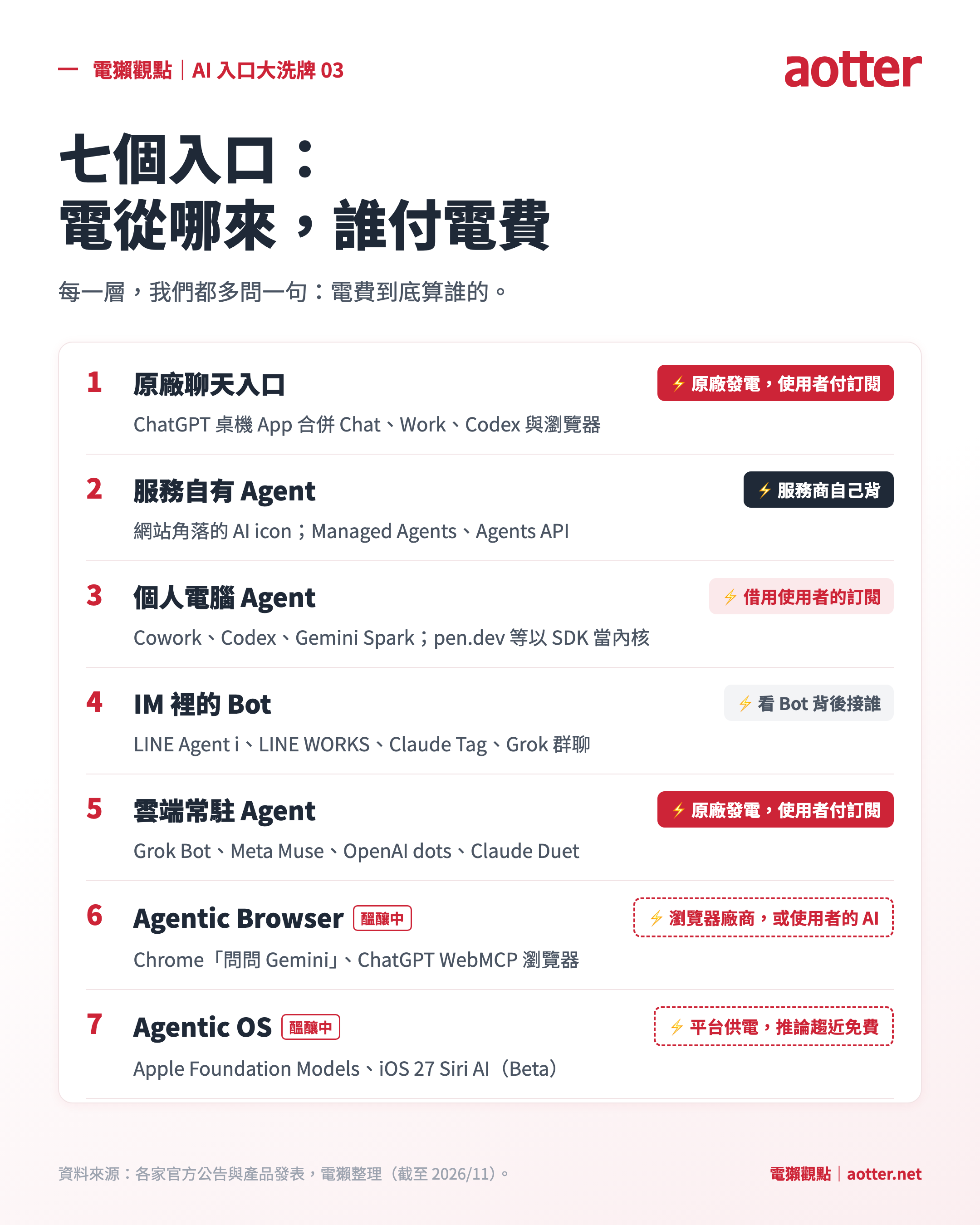
We counted up the entry points into AI — there are seven. This article goes through them layer by layer, and along the way figures out where the "electricity" comes from at each layer and who pays the "electricity bill."
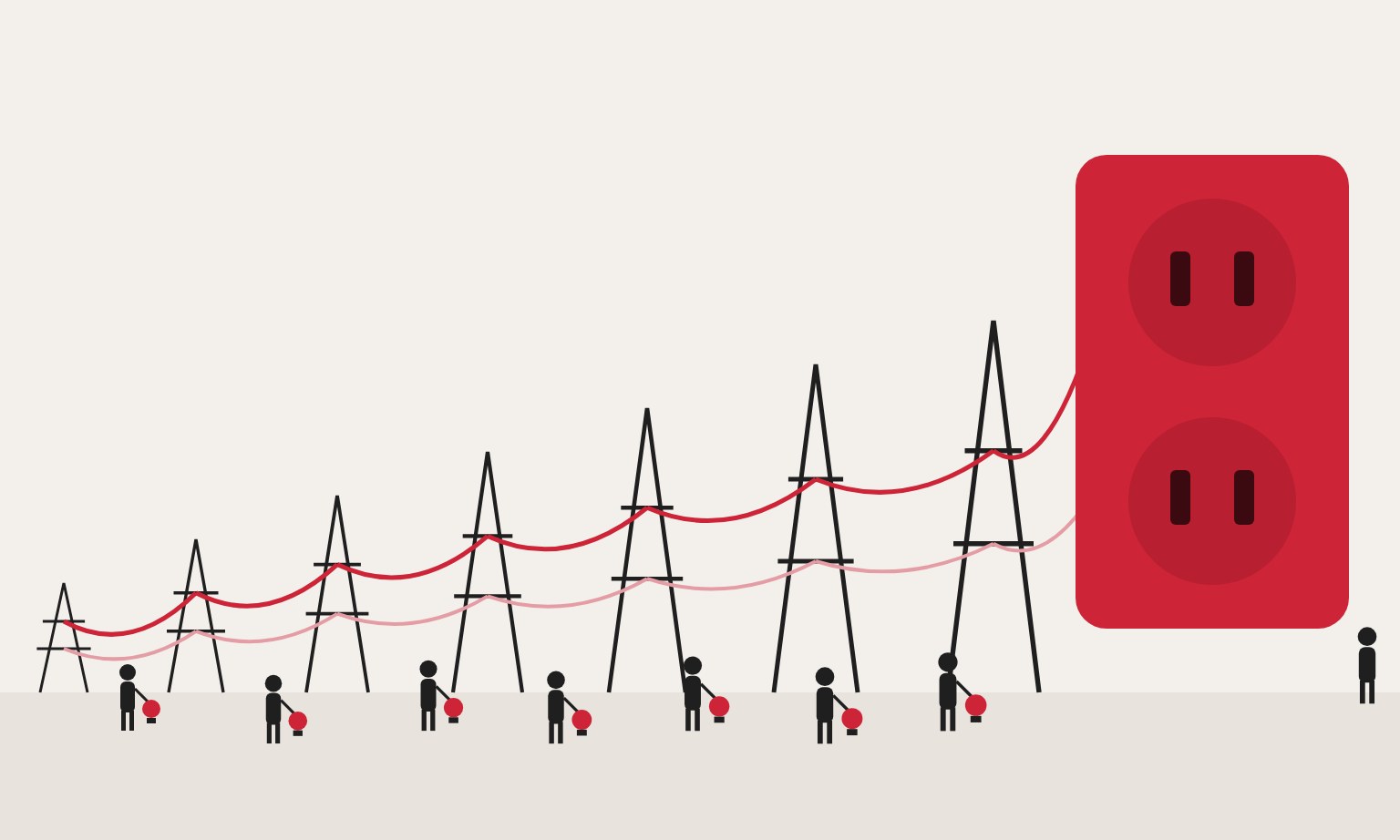
We count them up, and there are seven AI entry points. This piece goes through them layer by layer, and along the way works out where the "electricity" for each layer comes from, and who pays the "electric bill." Those of us in ad tech are especially sensitive to entry points: whoever controls the entry point gets paid. PC, search, social, mobile — every time the device changes, the entry point changes too. Now it's AI's turn.
The entry point is changing hands again
It's now November 2026. There's no doubt that AI has redistributed the map of entry points through which users access the internet.
As people in ad tech, we feel this especially keenly. Looking back at the history of digital advertising: personal computers brought portal sites and banner ads, Google brought keyword ads, Facebook brought personalized ads, the iPhone moved everything onto mobile. Every business that lives off entry points has had to relocate each time.
AI is the next handover. But this time there's a question that didn't exist before: as a software service provider, we don't just have to chase the entry point — we also have to worry about who pays the "electric bill."
To sell electricity, you also have to sell lamps
We often compare the current moment to the early days when electricity first became commercialized. Back then there was no power grid, so whoever sold electricity had to generate it themselves, run the lines themselves, and sell light bulbs on the side — otherwise nobody would buy the electricity.
That's exactly what the model vendors are doing now. Generating power means training models and providing compute; distributing power means APIs and billing; and then they go all the way to the end device too: web chat, mobile apps, desktop agents, CLI, and this second half of the year they've even handed you a cloud computer.
There's nothing wrong with the vendors doing everything end-to-end — without lamps, electricity can't be sold. What's getting stuck is us, the ones selling the appliances.
The service providers' electric bill problem
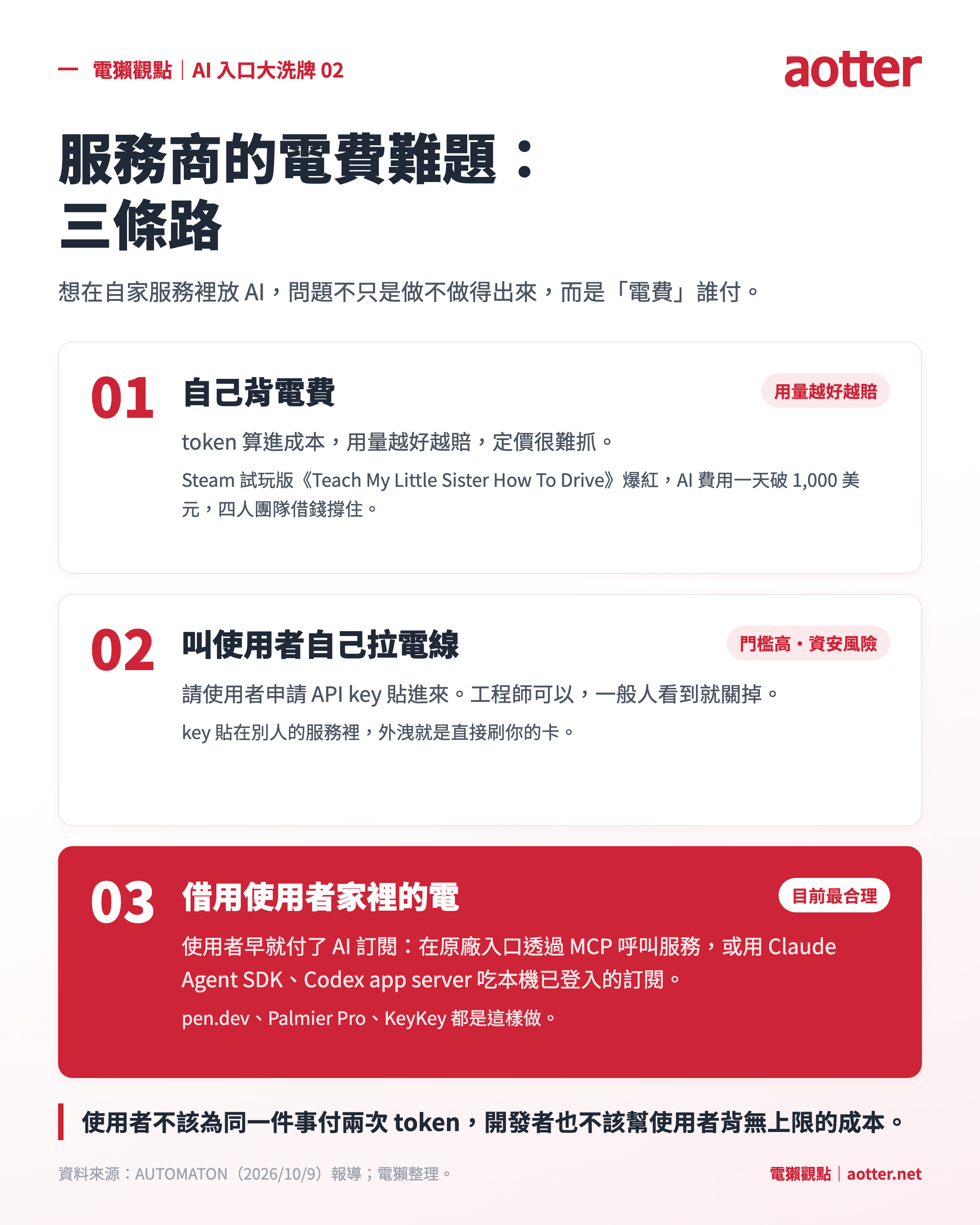
For service providers like us who sell appliances, the biggest headache right now is: users don't have electricity at home to use. If you want to put AI into your own service, over the past two years there have basically been three paths:
- Carry the electric bill yourself. Tokens get counted as cost, and the better the usage, the more you lose money, making pricing very hard to set. AI games cry about this the most: the Steam demo of "Teach My Little Sister How To Drive" went viral in Japanese streaming circles, player numbers grew more than twentyfold in a month, AI costs exceeded $1,000 a day, and the four-person team had to borrow money from a bank just to keep it running.
- Ask users to run their own power line. Have them apply for an API key and paste it in. Engineers can do this, but ordinary people just close the app when they see it. The security risk is also high: a key pasted into someone else's service means a leak charges straight to your card.
- Borrow the electricity already at the user's home. The user has already paid for an AI subscription, so let them call us through the vendor's entry point via MCP; or, like the pen.dev design tool, Palmier Pro, and the KeyKey editing software, directly use the Claude Agent SDK or the Codex app server to tap into the subscription already logged in on the user's computer.
The third path is currently the most reasonable one. Our principle is simple: users shouldn't have to pay for the same token twice, and developers shouldn't have to shoulder unlimited costs on behalf of users.
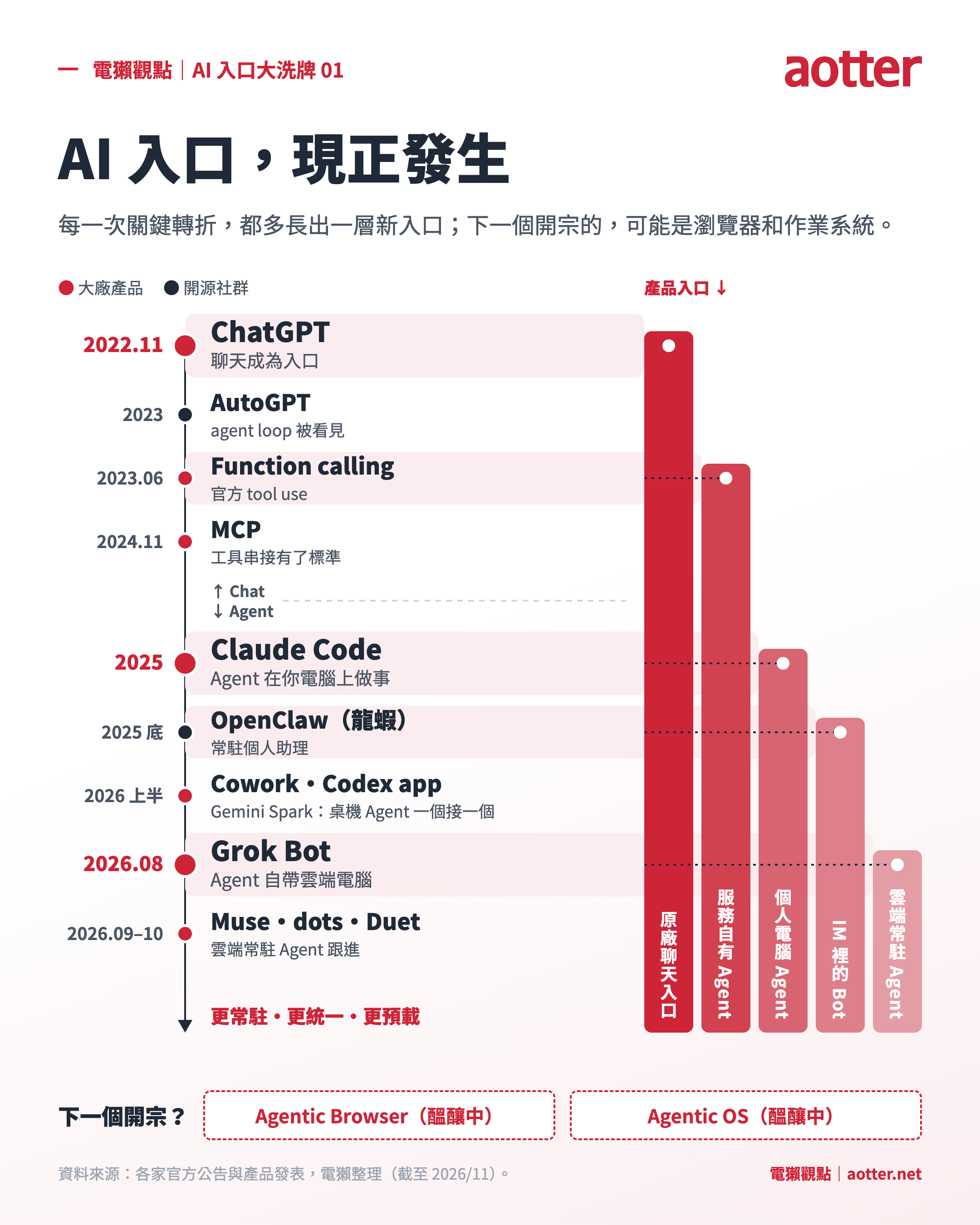
Map of user entry points: what's happening at each layer
Let's first go through where users currently encounter AI. For each layer, we'll ask one more question: where does the electricity come from, and who pays the electric bill?
Vendors' own chat entry points
Electric bill | The vendor generates the power, the user pays the subscription
OpenAI still has the largest coverage, with Anthropic, Google, xAI, and Meta continuing to race against each other, going all the way from web to mobile app, desktop app, and CLI. The chat box is also no longer the endpoint: in July, ChatGPT merged Chat, Work, Codex, and a built-in browser into one desktop app — everyone is turning the chat entry point into a one-stop workbench for getting things done.
Services' own agents
Electric bill | The service provider carries it themselves
More and more websites now have an AI icon in the upper-right or lower-right corner, whose strength lies in having prior knowledge of the service and being able to integrate deeply with it. The vendors, meanwhile, use MCP to pull the service back into their own entry point — Claude Managed Agents launched in April, and OpenAI followed a while later in September with the Agents API, both trying to tie the underlying layer of services into their own ecosystems.
Personal computer agents
Electric bill | Borrowing the user's subscription
After being startled awake by the lobster, the big players have been racing to add features: Cowork has been steadily adding functionality, Codex has integrated with the ChatGPT desktop app, and Gemini Spark is also fighting for "here's your computer, go finish this for me." Tool software like pen.dev, Palmier Pro, and KeyKey use the Claude Agent SDK or Codex app server directly as their core.
Bots inside IM
Electric bill | Depends on what's behind the bot
The lobster wave got everyone connecting agents to Telegram and Slack bots, and platforms and vendors have been jumping in one after another too: LINE Yahoo has announced it will bring Agent i into chat rooms in Japan in 2026; LINE WORKS entered Taiwan in June, focused on group AI collaboration; and Anthropic launched Claude Tag that same month, bringing Claude into Slack. Grok already supports multi-bot group chats, and if humans are added in too, it could end up replacing IM altogether.
Always-on cloud agents
Electric bill | The vendor generates the power, the user pays the subscription
Grok Bot launched in an early beta in August, coming with a cloud computer that keeps working even when your laptop is closed, and it's still gradually expanding availability. Meta's Muse (September), OpenAI's dots (late September, DevDay), and Anthropic's Claude Duet (October research preview) have followed one after another.
Speaking of always-on cloud agents, we have to mention Manus. Back in March 2025, Manus already gave its agent a cloud computer of its own: hand it a task and it opens a browser, runs code and delivers the result, finishing the job even after the user closes the window. It was Manus that sparked people's imagination for this kind of always-on agent, and it was the first to show just how convenient an AI agent could be. Invite codes were almost impossible to get at the time — but sadly, the craze happened mainly in China, its influence overseas was limited, and it never grew into a global, phenomenon-level shift.
What happened next is even more telling. Meta announced in December 2025 that it would acquire Manus for about $2 billion; in April 2026 China's National Development and Reform Commission stepped in, prohibited the deal and ordered it unwound, and by August Manus was operating independently again. Muse, which Meta launched in September, likewise spins up a dedicated virtual machine in the cloud with a built-in browser to run tasks for you — it feels like it was built on the experience of Manus. Manus, for its part, launched 2.0 in late September, taking Muse head-on with Cloud Computer and a personal-agent app called "Cue."
It also tells us that the AI business wars of this new era have quietly begun in the market. Geopolitics now runs as deep into AI as it did into the critical industries of the past. It's no longer like the dot-com, Web 2.0 and mobile app eras, when companies could expand globally more or less quietly.
Agentic Browser (brewing)
Electric bill | The browser maker, or the user's own AI
Chrome comes preinstalled with "Ask Gemini" — not very usable yet, but not to be underestimated. The ChatGPT desktop app has built a browser that supports WebMCP, possibly aiming to challenge Chrome's position.
Agentic OS (brewing)
Electric bill | The platform supplies the power, basic inference approaches free
Apple introduced Foundation Models in 2025, then at WWDC 2026 added image input and the ability to connect third-party models like Claude and Gemini, with small developers even able to use Private Cloud Compute for free. Siri AI launched in beta along with iOS 27 in September, currently only supporting English — its grand transformation has only just begun.
The vendors go end-to-end at every layer
Looking back at these seven entry points, the vendors have gotten a foothold in almost every layer: at the service layer there's MCP and Managed Agents; for personal computers and always-on cloud agents, they're entering the fight themselves; for IM there's Claude Tag; for browsers there's the ChatGPT desktop app. They're not just defending their own chat box — the entire ecosystem wants a piece of the action.
Why the urgency? Perhaps they've judged that Agentic OS will eventually mature, and if they don't lock in users now, there won't be a chance later. And of course, you don't put all your eggs in one basket.
OpenAI is the most ambitious. On the left, it's fighting Chrome: the desktop app has a built-in browser with WebMCP, and in August it even hosted a WebMCP hackathon with Google Chrome, Cloudflare, and Shopify. On the right, it's kicking at Apple: it acquired Jony Ive's io to build hardware, with the first product expected to ship no earlier than February 2027.
On format, though, they're being quite pragmatic. GPTs will be retired on December 11, replaced by skills plus MCP-based plugins, and the ChatGPT desktop app even reads Claude's plugin marketplace format directly. MCP was originally pushed by Anthropic, and the two sides are increasingly converging. This is good news for service providers: build one set of tools and it works on both.
Open source demonstrates first, the big players follow
This wave of change in entry points has been driven in large part by the open source community. In 2023, AutoGPT let everyone see for the first time what an agent loop actually looks like. When the lobster went viral at the end of 2025, people realized what they actually wanted was an assistant that lived in IM, had memory, and could keep running continuously — sparking a craze of people scrambling to buy mac minis.
Then the big players caught up. When Cowork launched in January, the lobster was just about to go viral; the updates over the following months were almost all filling in the gameplay that lobster users had already gotten used to: scheduled tasks were added in February, and Dispatch, which lets you delegate tasks remotely from your phone, launched in March. Desktop agents from various companies came out one after another as well. As for the always-on cloud agent wave, that's been more a case of the big players chasing each other.
By the time of the proactive agent wave, the big players had essentially filled in the last scenario that the lobster had already demonstrated: the computer closed, the assistant still running continuously in the cloud. The lobster can be considered to have accomplished its mission and stepped aside.
Open source may not always win the entry point, but it's responsible for showing everyone what the demand looks like, forcing the vendors to send power further out.
The outlet has been officially standardized, but the specs still aren't unified
Back to the third path mentioned earlier: borrowing the electricity already at the user's home. At the end of September, OpenAI's DevDay introduced "Sign in with ChatGPT," which effectively formalizes this path. Users log into third-party apps with their ChatGPT account, and their subscription usage can carry over, without needing an API key. You can even set a weekly limit for each app — once it hits the cap, it stops, instead of quietly switching over to billing on the app's side.
This design is almost exactly the kind of revenue split we had in mind as ideal. That said, it's still in preview: open source tools and personal projects running locally can already use it directly (since you could already farm usage through the Codex app server anyway), but paid apps, or services running on remote servers, still need to apply separately. The outlet exists, but it hasn't been opened up to everyone yet.
Another reality is that the vendors don't have a consistent stance yet on "whether a subscription can be carried over to third parties" — some allow it, some restrict it, and some don't have a channel for it at all. Each has its own reasoning. Opening it up can grow the ecosystem, and incidentally plants your flag at the front door of someone else's app; restricting it also makes sense, since subscription pricing is essentially a subsidy war, and once agents start running, the costs are on a completely different scale.
Using the history of electrical power as an analogy, this is a bit like the era when AC and DC power were still fighting it out: the electricity exists, but which plug fits depends on which power company you're connected to. Honestly, right now there really are just two plug types on the market: the OpenAI-compatible format and the Claude format, with almost every other model choosing one side or building compatibility with both — exactly like the AC/DC rivalry.
The real power grid: Agentic Browser and Agentic OS
Of the seven entry points, in the end, there might really only be these two left: the browser and the operating system. The reason is simple: users are lazy, and the power of "free" and "preinstalled" is enormous.
All web services run inside a browser, and all software runs inside an operating system. High market share means you just sit back and harvest.
The Gemini button in the top-right corner of Chrome still isn't very good right now, and Siri left everyone in despair for years before finally getting Siri AI in beta in September — but these are preinstalled on most people's devices. On Apple's side, the unified memory architecture is an incredibly strong buff: when the on-device model is good enough, it computes locally; when it's not, it escalates to Apple's own cloud. On the browser side, once WebMCP becomes widespread, websites just need to expose their tools, and the browser's agent will be able to use the user's own AI to operate them.
There's no doubt that OS makers and browser makers will favor their own AI. But they can give service providers a unified outlet: the user has electricity at home, there's only one plug standard, and which power company it's actually connected to matters much less to us.
For service providers, this is the real power grid. There's an outlet on the wall, and we no longer need to worry about whether the user has electricity at home or which power company they're connected to. We can finally specialize and focus on making good appliances.
We're betting on the appliance layer
So we're not betting on any particular power company — we're betting on the appliance.
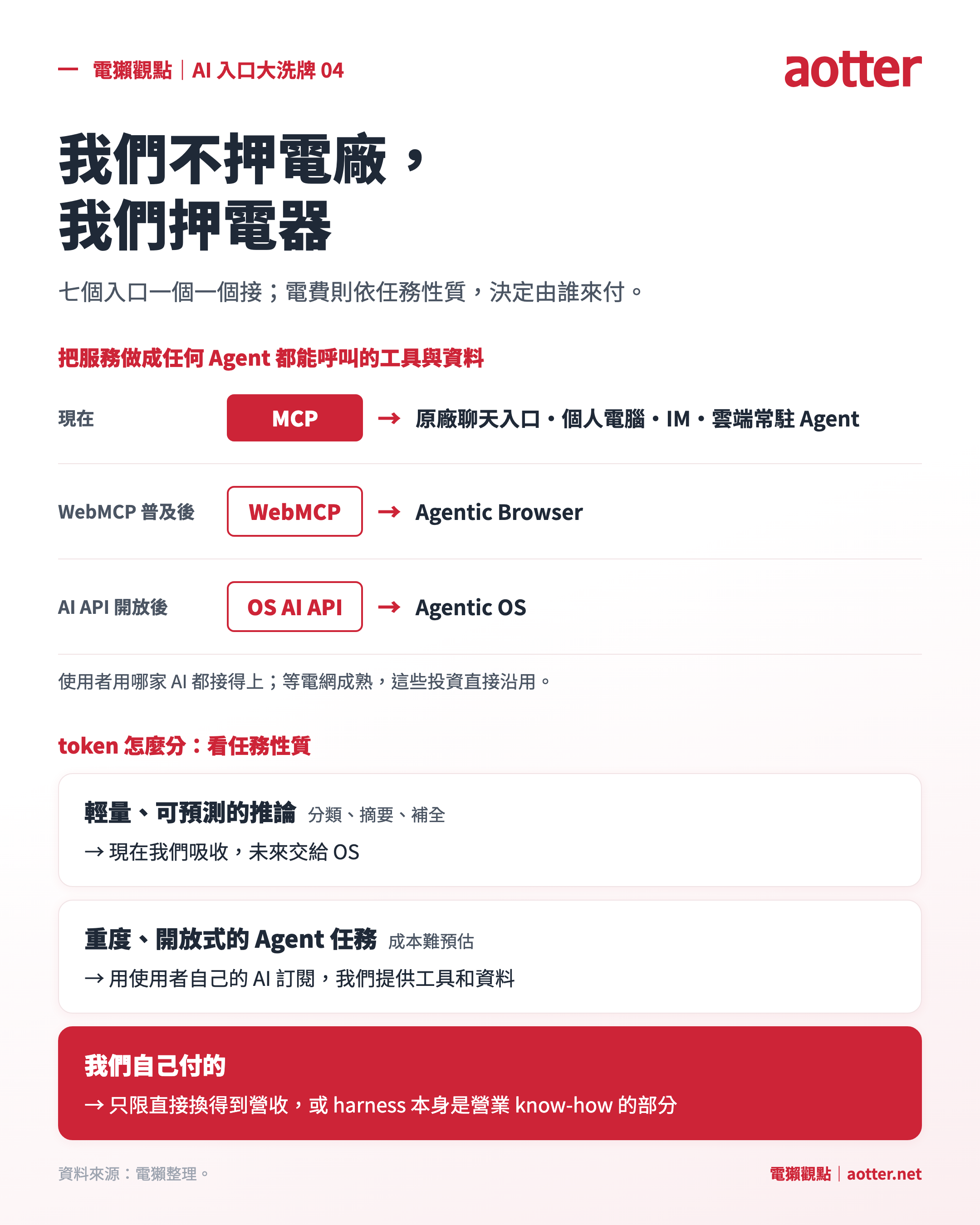
More precisely, that means turning our service into tools and data that any agent can call, and connecting it one by one to the seven entry points: for the vendors' chat entry points, personal computers, IM, and always-on cloud agents, we're connecting via MCP right now; for the browser layer, we'll follow as soon as WebMCP becomes widespread; for the OS layer, we'll connect as soon as Apple's AI API opens up. It works no matter which AI the user uses; and once the power grid matures, these investments carry straight over — no need to start from scratch.
As for how we split the tokens, we look at the nature of the task:
- Lightweight, predictable inference, like classification, summarization, completion: we absorb the cost now, and hand it off to the OS in the future.
- Heavy, open-ended agent tasks: use the user's own AI subscription, with us providing the tools and data.
- What we pay for ourselves, limited to parts that directly convert into revenue, or where the harness itself is our business know-how.
After the power grid becomes widespread
Once the power grid becomes widespread, that also means new gatekeepers will rise. Everyone's familiar with the App Store cut story — will OS and browser makers restrict APIs or favor their own services, taking a toll on AI too? And whoever's paying for the portion where on-device models aren't powerful enough and have to go to the cloud — who's that on? Maybe in a future where hardware compute bottlenecks get solved and inference costs drop, everyone gets free tokens to use? And if you want more, maybe it gets bundled and charged as part of an iCloud+ or Google One family package?
None of this has an answer yet. But we think the direction is clear: AI will increasingly resemble water and electricity utilities, and the ecosystem will eventually specialize: the model vendors will return to the role of infrastructure, generating and distributing power like a power company; the entry point will be handed over to browsers and OSes; and the value of service providers will return to the appliance itself. We'll keep watching.
Sources
- AUTOMATON, Developers of AI-powered driving game take out loan to keep Steam demo running after surge in players pushes AI costs past $1,000 a day
- InfoWorld, Meta’s ex launches agent rival to Meta’s Muse (Sept 29, 2026)
- INSIDE, 20 億美元併購案告吹!中國官方出手,攔截 Meta 對 Manus AI 的收購
- Trends across entry points: official announcements and product launches from OpenAI, Anthropic, Google, xAI, Meta, Apple, and LINE, compiled by Aotter (as of November 2026).
 AI Advisory · Powered by MCP
Want to go deeper? Make AOTTERSMAN your AI advisor
The full reasoning and hands-on checklist behind this insight live in the AOTTERSMAN knowledge base. Install the MCP and your existing AI assistant (Claude / Cursor / Gemini…) can tap AOTTERSMAN's thinking frameworks directly — like having an extra AI advisor always on call.
Permission governance you can trust
Fine-grained data permissions ensure the right people — and the right AI — see the right data.