To Sell Electricity, You Also Have to Sell Lamps: AI's Seven Entry Points — Which Layer Should Service Providers Bet On?
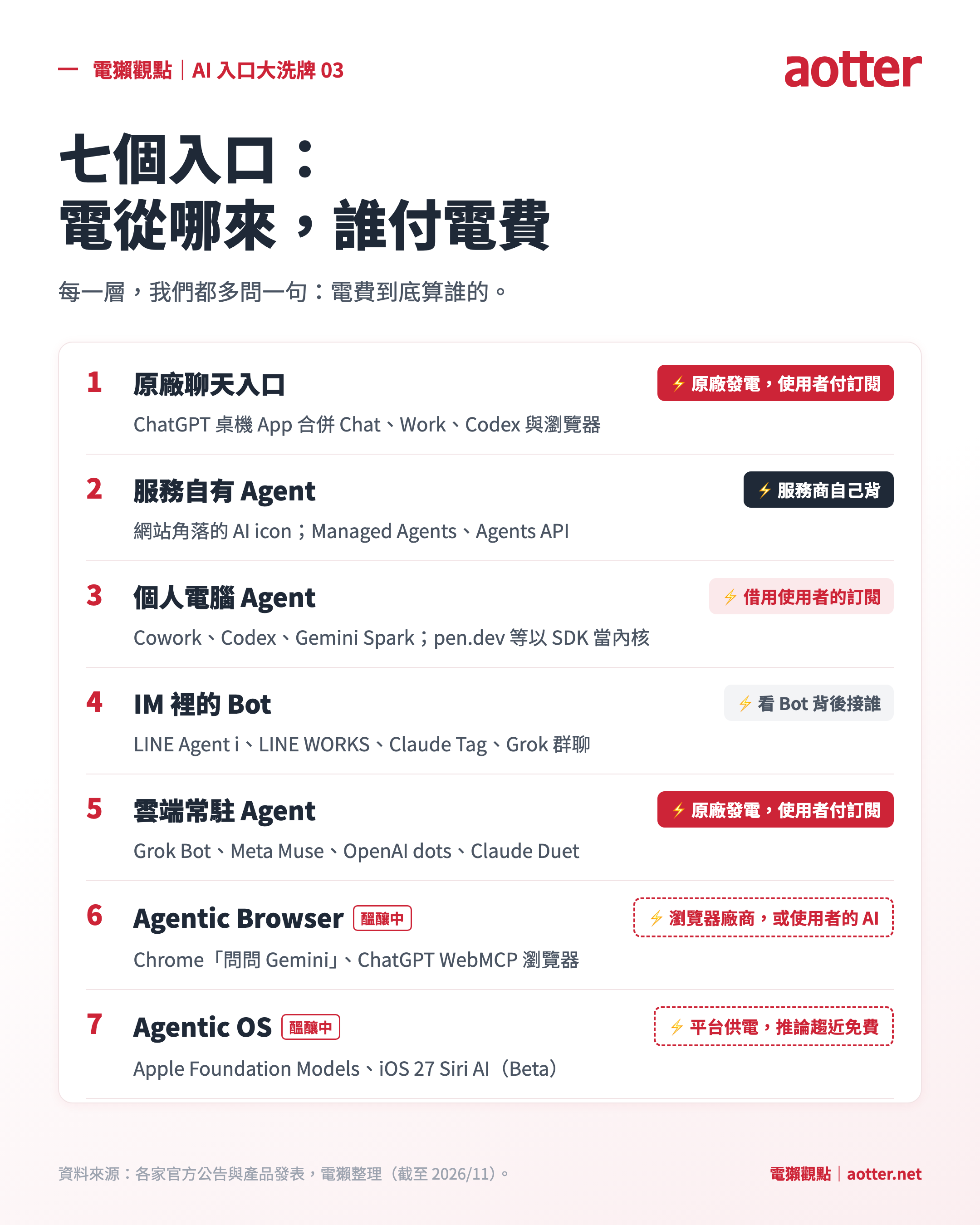
We counted up the entry points into AI — there are seven. This article goes through them layer by layer, and along the way figures out where the "electricity" comes from at each layer and who pays the "electricity bill."
Map of user entry points: what's happening at each layer
Let's first go through where users currently encounter AI. For each layer, we'll ask one more question: where does the electricity come from, and who pays the electric bill?
Vendors' own chat entry points
Electric bill | The vendor generates the power, the user pays the subscription
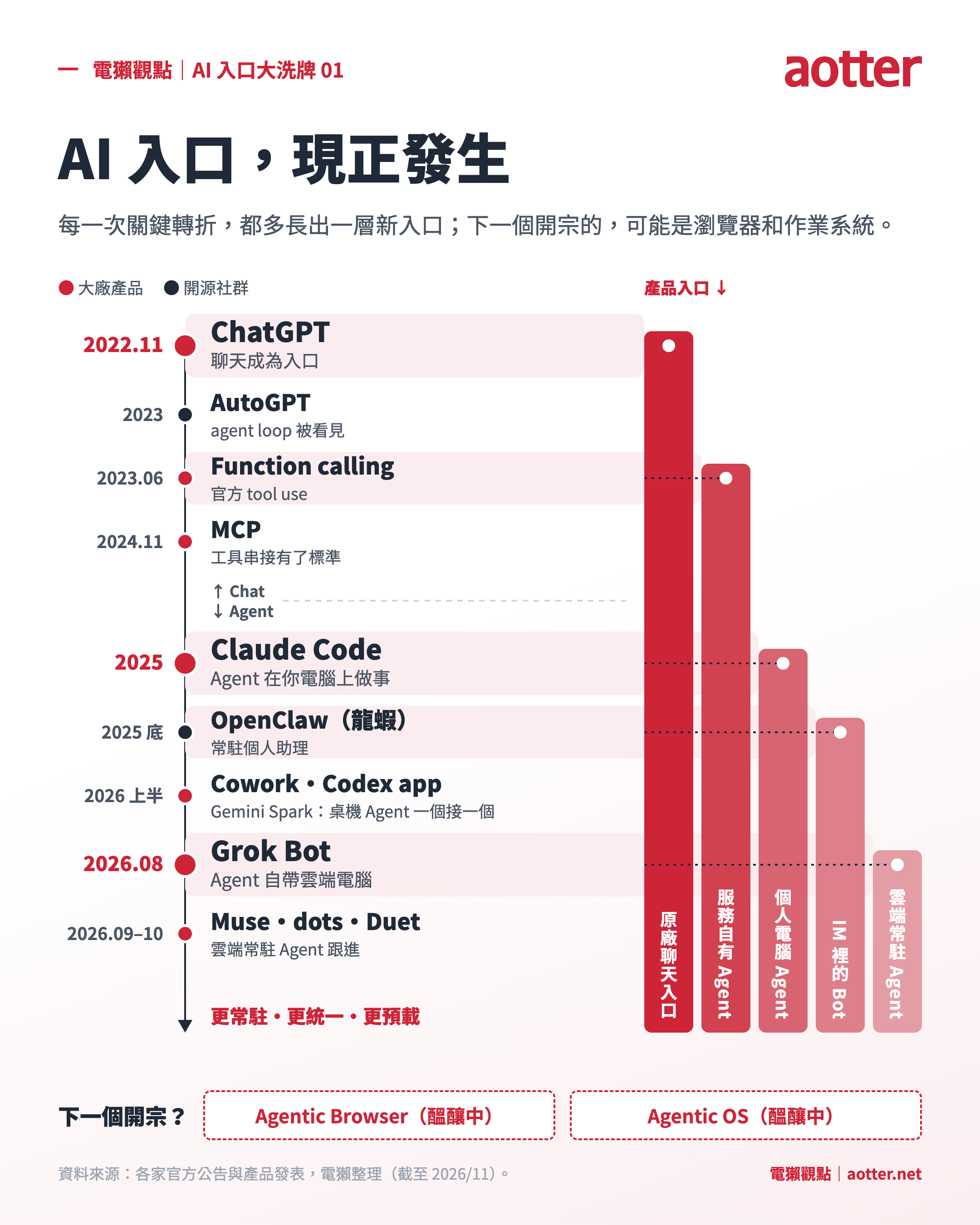
OpenAI still has the largest coverage, with Anthropic, Google, xAI, and Meta continuing to race against each other, going all the way from web to mobile app, desktop app, and CLI. The chat box is also no longer the endpoint: in July, ChatGPT merged Chat, Work, Codex, and a built-in browser into one desktop app — everyone is turning the chat entry point into a one-stop workbench for getting things done.
Services' own agents
Electric bill | The service provider carries it themselves
More and more websites now have an AI icon in the upper-right or lower-right corner, whose strength lies in having prior knowledge of the service and being able to integrate deeply with it. The vendors, meanwhile, use MCP to pull the service back into their own entry point — Claude Managed Agents launched in April, and OpenAI followed a while later in September with the Agents API, both trying to tie the underlying layer of services into their own ecosystems.
Personal computer agents
Electric bill | Borrowing the user's subscription
After being startled awake by the lobster, the big players have been racing to add features: Cowork has been steadily adding functionality, Codex has integrated with the ChatGPT desktop app, and Gemini Spark is also fighting for "here's your computer, go finish this for me." Tool software like pen.dev, Palmier Pro, and KeyKey use the Claude Agent SDK or Codex app server directly as their core.
Bots inside IM
Electric bill | Depends on what's behind the bot
The lobster wave got everyone connecting agents to Telegram and Slack bots, and platforms and vendors have been jumping in one after another too: LINE Yahoo has announced it will bring Agent i into chat rooms in Japan in 2026; LINE WORKS entered Taiwan in June, focused on group AI collaboration; and Anthropic launched Claude Tag that same month, bringing Claude into Slack. Grok already supports multi-bot group chats, and if humans are added in too, it could end up replacing IM altogether.
Always-on cloud agents
Electric bill | The vendor generates the power, the user pays the subscription
Grok Bot launched in an early beta in August, coming with a cloud computer that keeps working even when your laptop is closed, and it's still gradually expanding availability. Meta's Muse (September), OpenAI's dots (late September, DevDay), and Anthropic's Claude Duet (October research preview) have followed one after another.
Speaking of always-on cloud agents, we have to mention Manus. Back in March 2025, Manus already gave its agent a cloud computer of its own: hand it a task and it opens a browser, runs code and delivers the result, finishing the job even after the user closes the window. It was Manus that sparked people's imagination for this kind of always-on agent, and it was the first to show just how convenient an AI agent could be. Invite codes were almost impossible to get at the time — but sadly, the craze happened mainly in China, its influence overseas was limited, and it never grew into a global, phenomenon-level shift.
What happened next is even more telling. Meta announced in December 2025 that it would acquire Manus for about $2 billion; in April 2026 China's National Development and Reform Commission stepped in, prohibited the deal and ordered it unwound, and by August Manus was operating independently again. Muse, which Meta launched in September, likewise spins up a dedicated virtual machine in the cloud with a built-in browser to run tasks for you — it feels like it was built on the experience of Manus. Manus, for its part, launched 2.0 in late September, taking Muse head-on with Cloud Computer and a personal-agent app called "Cue."
It also tells us that the AI business wars of this new era have quietly begun in the market. Geopolitics now runs as deep into AI as it did into the critical industries of the past. It's no longer like the dot-com, Web 2.0 and mobile app eras, when companies could expand globally more or less quietly.
Agentic Browser (brewing)
Electric bill | The browser maker, or the user's own AI
Chrome comes preinstalled with "Ask Gemini" — not very usable yet, but not to be underestimated. The ChatGPT desktop app has built a browser that supports WebMCP, possibly aiming to challenge Chrome's position.
Agentic OS (brewing)
Electric bill | The platform supplies the power, basic inference approaches free
Apple introduced Foundation Models in 2025, then at WWDC 2026 added image input and the ability to connect third-party models like Claude and Gemini, with small developers even able to use Private Cloud Compute for free. Siri AI launched in beta along with iOS 27 in September, currently only supporting English — its grand transformation has only just begun.
 AI Advisory · Powered by MCP
Want to go deeper? Make AOTTERSMAN your AI advisor
The full reasoning and hands-on checklist behind this insight live in the AOTTERSMAN knowledge base. Install the MCP and your existing AI assistant (Claude / Cursor / Gemini…) can tap AOTTERSMAN's thinking frameworks directly — like having an extra AI advisor always on call.
The first step of enterprise AI transformation
Get data governance right first, so AI projects don't stall on messy data.