Data Deep Dive: How Much Traffic Will Be Lost Without the Boost from PTT Gossiping Board? Are SET News and Mirror News Facing a Traffic Winter?
The moderator of PTT's Gossiping board, ubcs, officially announced a gag order and ban on the evening of July 30, 2026 — what effects will this bring? Let the data do the talking.

On July 30, 2026, the moderator of PTT's Gossiping board announced a ban on links from SET News and Mirror Media. SET News was questioned over a sensationalized report involving a homicide case that was allegedly inaccurate, with the victim's family protesting without receiving a proper correction; Mirror Media faced an even harsher penalty due to disputes over inaccurate reporting related to Korea. The moderator stated bluntly: "The law can't touch you, but board rules can." This move immediately sparked heated debate across social platforms over media literacy versus censorship.
Following the incident, many people have been discussing the current predicament facing Taiwan's media.
When it comes to driving traffic from PTT, Dcard, and Meta-related platforms (Facebook, Instagram, Threads), the latter two currently have their limitations, while PTT is the forum most capable of directly feeding traffic to media outlets. This gives us an opportunity to study what kind of consequences this ban will actually trigger. Looking at the results, PTT Gossiping board's ban on SET News and Mirror News might seem on the surface like just a loss of a few million clicks per month, but in reality, it severs one of the most important "SEO moats" and "high-engagement traffic pools" that these two media outlets have within Taiwan's internet ecosystem.
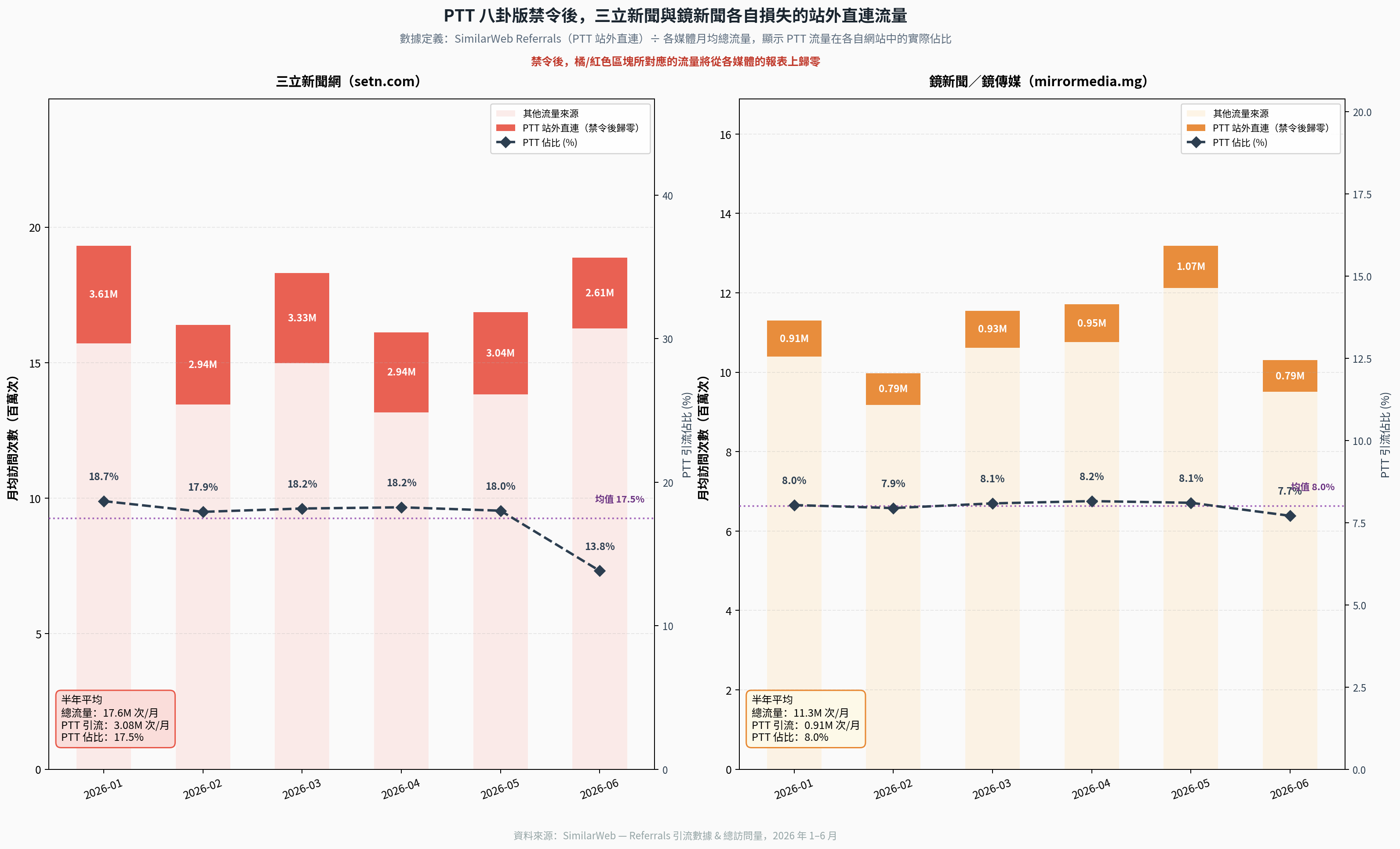
Let's first look at the cold, hard numbers. If PTT's Gossiping board really does fully block domain links from these two media outlets, SET News will directly lose an average of about 3.08 million clicks per month, accounting for 17.5% of its average monthly total traffic; Mirror News will lose about 910,000 clicks, accounting for 8.0% of its average monthly total traffic. In other words, one out of every six clicks to SET News comes from PTT, while for Mirror News it's one out of every twelve. This is not marginal traffic that can be brushed aside — it's a crucial channel that steadily delivers traffic to both media outlets every month, and the moment the ban takes effect, it drops to zero instantly. Given the current shifting landscape of traffic-driving channels, this is no small blow.
 But if you think this is just about losing a few million page views per month, the consequences could actually be far more severe than you'd expect. We need to zoom out and look at what's currently happening in the broader internet traffic ecosystem:
First, PTT should never be viewed as a single traffic source. Within Taiwan's internet environment, PTT has countless "shadow clones." As soon as an article is posted on the Gossiping board, it's immediately scraped by countless crawler sites and mirror sites like Disp BBS and PTT Web. What does this mean? It means that a simple URL share can instantly generate dozens of backlinks from high-authority websites for that news site. In the world of search engine optimization (SEO), this is essentially a gift from the heavens. When the Gossiping board bans sharing their links, this automatically running SEO backlink-generating machine gets completely shut off. Over time, these two media outlets' rankings in Google search results are bound to take a serious hit.
Even more critical is the fact that we're now entering the era of AI search (AEO, AI Engine Optimization). Whether it's ChatGPT, Perplexity, or Manus, these AI tools rely heavily on forum discussion volume when judging the authority and relevance of a news story. When your news link can't be discussed or cited on Taiwan's most influential forum, AI will conclude that your content "lacks discussion value." This is an extremely dangerous warning sign for future traffic strategy.
So, can they make up for this gap with today's hottest social platforms? It's unlikely.
Let's look at Meta (Facebook and Instagram). Anyone familiar with social media operations knows that Meta's current algorithm has only one core logic: keep users locked firmly onto its own platform. They hate driving traffic out to external websites. If you write an in-depth article with a news link attached, your reach gets slashed to the bone instantly. Media social media managers now have to play cat-and-mouse games like "put the link in the comments." So counting on Meta alone to fill this 4-million traffic gap? That's an unrealistic fantasy — not to mention that if media outlets have to pay out of pocket for social media ads to acquire users, the return ratio between exposure clicks and content has already become worse than before.
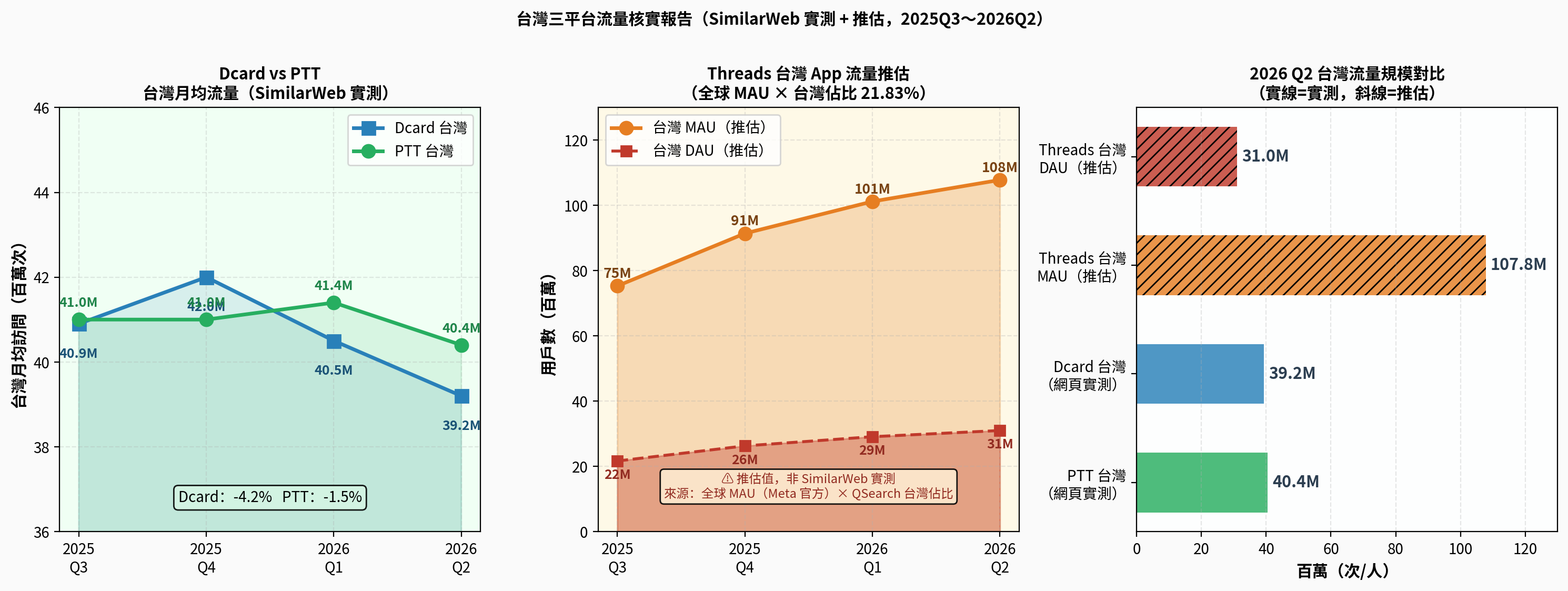
What about Threads, which has been quite popular lately? Here we need to expose a blind spot in the data. If you only look at web-based traffic analytics tools (like SimilarWeb), you'd think Threads' traffic in Taiwan is pitifully low, even showing an avalanche-like decline. But in fact, from the start of its service until now, Threads has become a "purely app-driven" platform, and web version data is essentially just an afterimage.
The real situation is this: Threads' global app monthly active users (MAU) continue to climb, and Taiwan is actually one of Threads' largest strongholds globally, contributing as much as 21.83% of global traffic, ranking first in the world [2]. If we work backward using this ratio, Threads' app MAU scale in Taiwan has already surpassed 100 million (this includes a large amount of cross-device and non-logged-in browsing), far exceeding the web-side traffic of both Dcard and PTT, and also surpassing both of their app MAUs (though this figure is only an estimate, with no exact numbers available).
However, while Threads' traffic is indeed staggeringly large, for media outlets, this is a poisoned apple that "looks good but can't be eaten." The essence of Threads is a highly anonymous, emotionally charged, closed text-based community. People are used to taking screenshots, venting emotions, and engaging in written arguments there, but they simply "don't click links." It's an excellent venue for brand exposure, but as a traffic-driving tool, its conversion rate is pitifully low. Trying to use Threads to drive people back to a news website? That's an almost impossible task.
And amid Threads' aggressive rise, Dcard hasn't had an easy time either. Although Dcard's web traffic appears relatively stable (holding at around 40 million monthly visits on average), Dcard is also a platform highly dependent on its app. According to real data disclosed by Dcard's internal creators, their app-side article reach has plummeted from a past average of 10,000 views to less than 3,000, a drop of more than 70% 3. Young users' attention is being massively siphoned away by Threads.
In contrast, PTT, this veteran forum, has shown remarkable resilience. Because PTT itself has no official app, a large number of users rely on the web version or third-party open-source apps to access it, so its web traffic can better reflect its true underlying strength. Data shows that PTT still maintains a stable average of 41 million monthly visits from Taiwan [4].
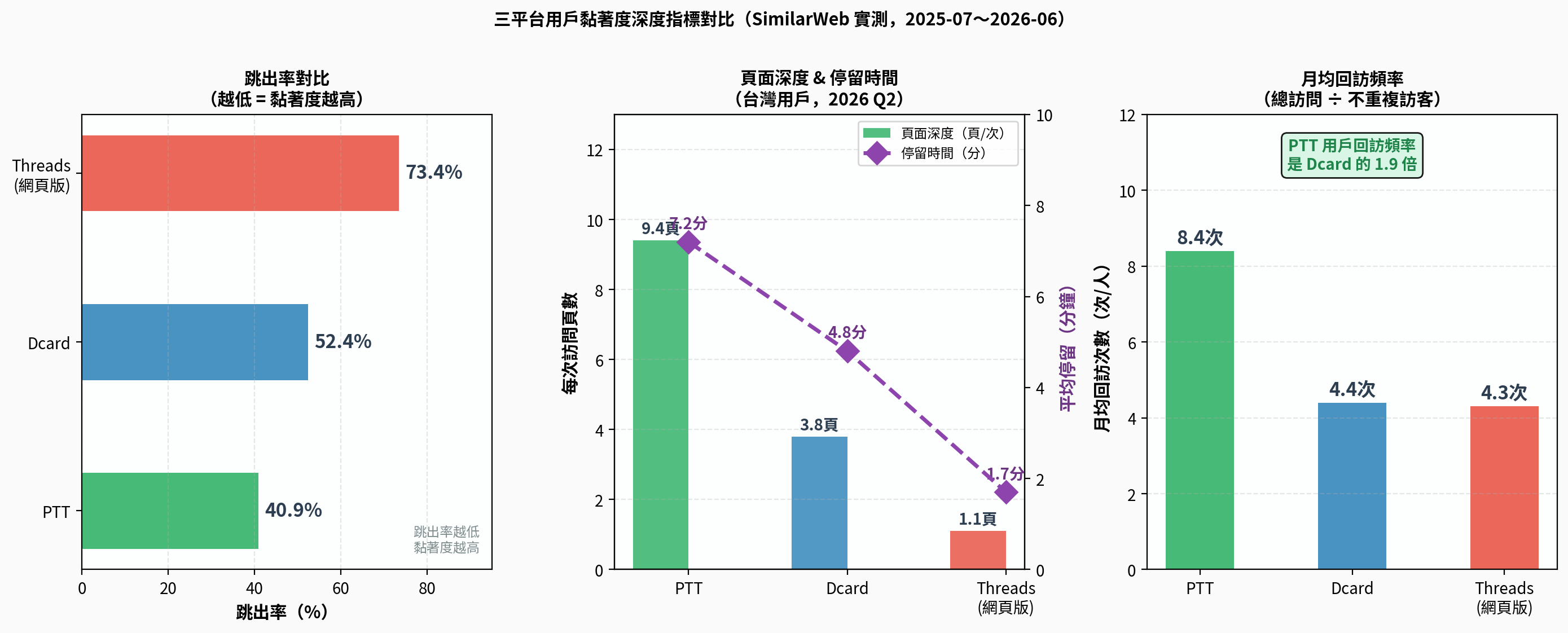
Even more critical is "engagement." PTT's bounce rate is only 40.9%, far lower than Dcard's 52.4% and Threads web version's 73.4% [4]. PTT users view an average of 9.4 pages per visit, stay for over 7 minutes on average, and return an average of 8.4 times per person per month — nearly double that of Dcard. This shows that PTT's users don't just represent large volume, they're truly "high-value users" who stay to read content and click on links.
This is the predicament these two media outlets are about to face. From past operational experience, we clearly understand PTT's traffic characteristics: it's not a one-time firework, but a spark that keeps smoldering. A news story that blows up on the Gossiping board often triggers follow-up coverage from other media outlets, and can even become material for evening political talk shows, forming powerful secondary and tertiary waves of dissemination. Eventually, it shapes the scope of online discussion and becomes source material referenced by all kinds of content creators, which then gets transformed into various forms of digital content on other platforms.
When this spark is extinguished — with Meta not giving traffic, Threads unable to drive users out, Dcard's app side quietly bleeding users, and the highly-engaged PTT now banning them — these two media outlets will face a dramatic surge in the cost of acquiring future traffic, caught in a squeeze from all four sides. They may have to rely even more heavily on LINE official account push notifications, or pray for the favor of Google Discover's algorithm. This isn't just about losing 3 million or nearly 1 million clicks per month — this is a crisis of the entire content distribution chain breaking apart. In an era where traffic is becoming ever more expensive, losing a free channel that automatically helps you do SEO, generates buzz, and brings in highly engaged users is undoubtedly a heavy, silent blow.
References
1 SimilarWeb traffic data analysis: PTT referral traffic statistics, January to June 2026 2 Yahoo News Taiwan (2025). Taiwan Becomes the World's Top Threads-Loving Country! Traffic Contribution Rate of 21.83%.3 Threads Creator Disclosure (2025). Dcard's traffic has dropped severely, possibly down to only 30% of its original level. 4 SimilarWeb Traffic Analytics (2026). Web traffic and engagement statistics for PTT, Dcard, and Threads.
 AI Advisory · Powered by MCP
Want to go deeper? Make AOTTERSMAN your AI advisor
The full reasoning and hands-on checklist behind this insight live in the AOTTERSMAN knowledge base. Install the MCP and your existing AI assistant (Claude / Cursor / Gemini…) can tap AOTTERSMAN's thinking frameworks directly — like having an extra AI advisor always on call.
Turn scattered data into consistent answers
Bring data from ERP, Excel, and NAS into one consistent layer your AI can safely tap.