When Enterprises Adopt AI, the First Hurdle Isn't the Model—It's the Data Scattered Across Excel Files
When discussing enterprise AI adoption, people tend to jump straight to asking which model to choose. But after years of talking with enterprises, the first real problem we often see is: where is the company's data, actually? And who knows what it represents?
Deployment methods, model selection, and implementation recommendations
Different enterprises have different requirements for data retention and model services. Some can use managed services in a public cloud environment, while others must keep everything in an enterprise private cloud, VPC, or on-premises data center. AotterClam AI's official documentation lists enterprise private cloud and on-premises deployment options, and explains that it supports configurable roles and permissions, operation logging, and offers different approaches such as local inference or connecting to external AI models. 5
When discussing "data doesn't leave the country" or "data doesn't leave the company," we recommend breaking that statement down into concrete data paths to verify. Where is the database itself located? Which region are backups and logs stored in? Where does model inference actually run? When a user asks a question, which fields, summaries, or query results does the system send to the model? Can support staff access the data? Who are the service provider's subprocessors? Simply answering "we're running it on-premises" isn't enough, because an enterprise system typically also includes backups, monitoring, updates, external models, and operational access channels.
Similarly, BYOK (Bring Your Own Key) generally refers to enterprises supplying their own API keys for model services; BYOAI is often used to describe enterprises choosing or bringing their own AI models and services. These are ways of adopting models and managing costs — they don't automatically mean data is protected, nor do they mean a personal ChatGPT or Claude subscription automatically includes enterprise API access. Whether a connection is actually possible, how billing works, whether data is used for model training, and how long logs are retained should all be confirmed according to the model provider's terms of service and the enterprise's deployment configuration.
MCP allows AI tools to connect to data services in a standardized way, but MCP itself is not a privacy protection protocol, nor does it automatically determine how much data should be exposed. Enterprises need to define the scope of data available for querying, field masking, role-based permissions, query logging, and policies on the use of external models. If a user only needs product inventory and sales trends, the system shouldn't expose customer phone numbers or addresses to the model just because they happen to live in the same database.
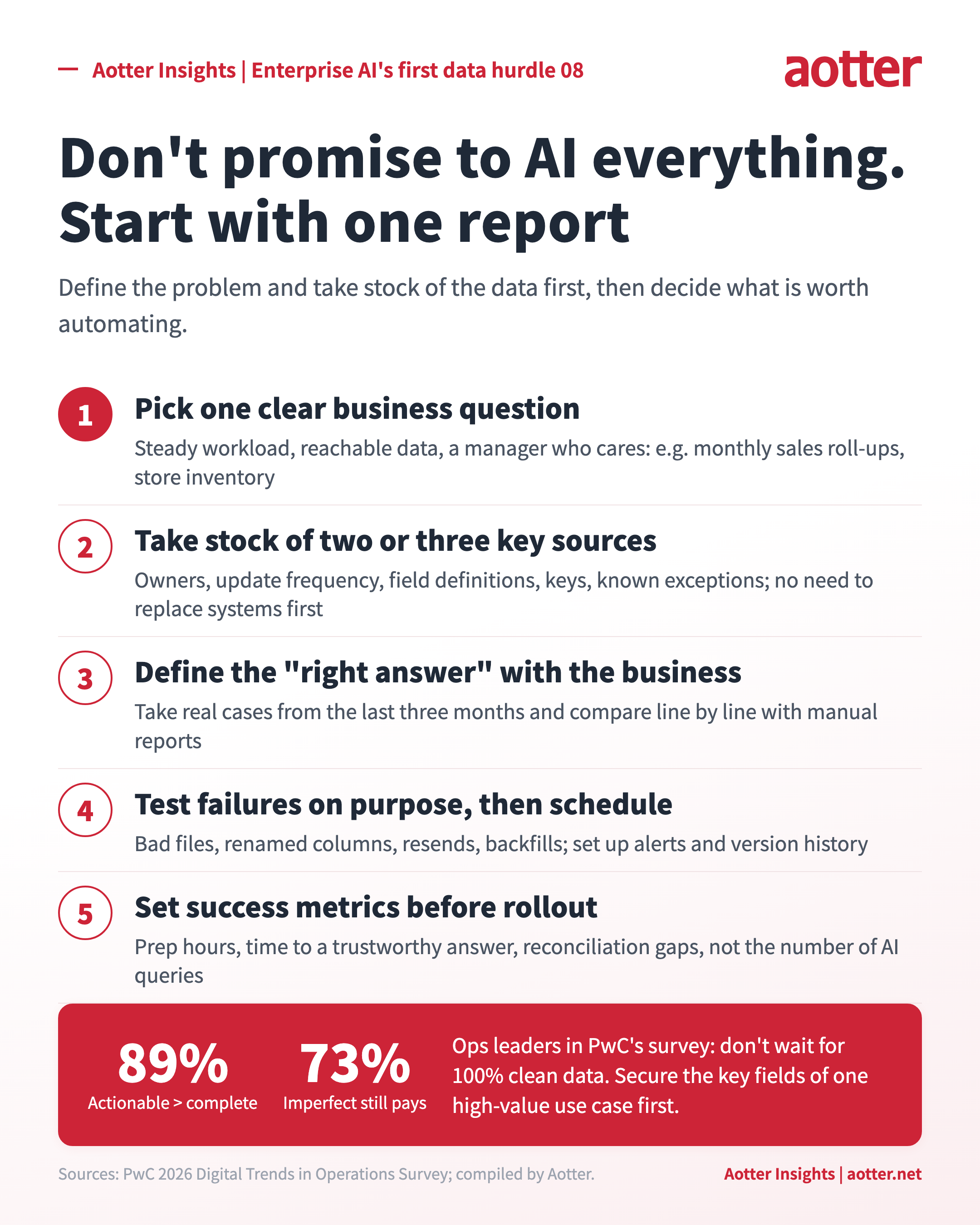
When implementing, we recommend starting with a clearly defined business question, rather than promising upfront that "all data will be AI-enabled." Enterprises can start by choosing a scenario with a steady workload, accessible data sources, and genuine management interest — for example, monthly sales aggregation, store inventory analysis, supplier lead-time tracking, or customer service issue classification. Clearly defining the target question first makes it possible to determine which data needs to be connected, which fields matter, and what the validation method should be.
Next, inventory the two or three most critical source documents or system outputs. Identify each dataset's owner, update frequency, field definitions, retention rules, primary key, and known exceptions. This step doesn't require replacing every system right away — first confirm whether existing data can be exported on a schedule, whether permissions allow the system to read it, and whether the data can be processed within the enterprise's designated environment. If data can currently only be sent manually, first lock down the sending method, file naming, and receiving rules, so the process is stable before expanding.
Then, work with the business side to define the criteria for a "correct answer." If the goal is monthly net sales, you need to at least specify how cancelled orders, refunds, discounts, tax, and shipping time are calculated; if the goal is inventory turnover, you need to agree on how beginning inventory, ending inventory, in-transit goods, and out-of-stock days are handled. You can pick real cases from the most recent three months and compare them line by line against existing manual reports, to identify exactly where the discrepancies lie in the rules — don't just test against one tidy sample file.
Only after that should validation and expansion be scheduled. Test common files, but also deliberately test error files, renamed fields, a sudden increase in null values, resent duplicate files, historical data backfills, and the addition of new codes. Once these pass, begin scheduled updates, and set up anomaly notifications, version retention, and a manual exception-handling process. When a second source is added, the enterprise can observe whether the data relationships remain stable before deciding whether to bring in a third department.
Success metrics should also be defined before starting. You can track things like how many hours colleagues spend each month organizing data, the time needed from asking a question to getting a trustworthy answer, the frequency of manual rework or reconciliation discrepancies, how many days managers wait for a report before making a decision, or changes in specific inventory and customer service metrics. If you only count how many times AI Q&A was used, it's easy to mistake "people tried it out" for "the business process actually improved." Only when an enterprise can clearly articulate the before-and-after difference can it know whether the next budget should go toward data quality, process automation, or more complex model applications.
Another observation from PwC's 2026 survey is worth incorporating into implementation strategy: among surveyed operations executives, 89% believe actionable data is more important than pursuing fully complete data, and 73% believe data doesn't need to be perfect to create value. This doesn't mean data errors can be ignored — it means enterprises don't have to wait until all data is "100% clean" before starting. A more practical approach is to first improve the quality of key fields for one high-value scenario, while continuing to improve the rest of the data, and use clear validation and risk tiering to hold the line. 2
 AI Advisory · Powered by MCP
Want to go deeper? Make AOTTERSMAN your AI advisor
The full reasoning and hands-on checklist behind this insight live in the AOTTERSMAN knowledge base. Install the MCP and your existing AI assistant (Claude / Cursor / Gemini…) can tap AOTTERSMAN's thinking frameworks directly — like having an extra AI advisor always on call.
More than a chatbot
AotterClam is an enterprise-grade AI control layer that lets AI truly understand your company's data.